Artificial Intelligence, Machine Learning, and Deep Learning are everywhere right now — from Netflix recommendations and Google Search to self-driving cars and tools like ChatGPT. But here’s the real problem: most people use these terms interchangeably, even though they’re not the same thing at all.
If you’ve ever asked questions like “Is machine learning the same as AI?”, “Where does deep learning fit in?” or “Which one should I actually learn or use?” — you’re not alone. This confusion is exactly why people struggle to understand how modern technology really works behind the scenes.
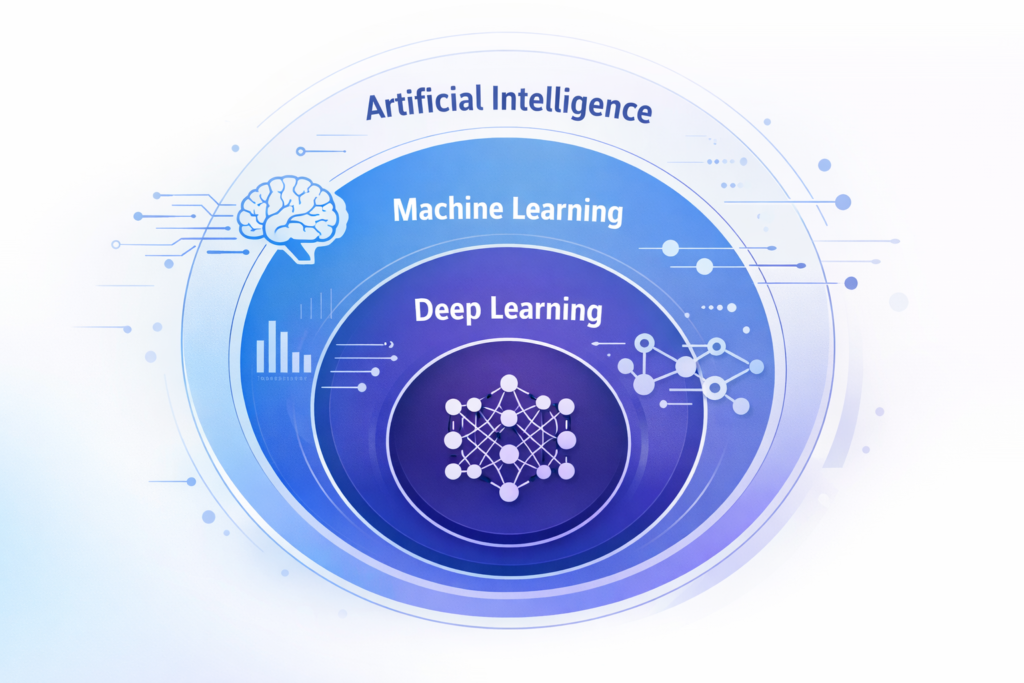
In simple terms, Artificial Intelligence (AI) is the big umbrella. Machine Learning (ML) is a subset of AI that learns from data instead of fixed rules. And Deep Learning (DL) is an advanced form of machine learning that uses neural networks to solve complex problems like image recognition, speech processing, and natural language understanding.
In this guide, we’ll break down AI vs Machine Learning vs Deep Learning in the most practical way possible — with real-world examples, clear differences, comparison tables, and decision logic. No jargon. No textbook talk. Just clarity.
By the end, you’ll know exactly what each term means, how they’re connected, and when to use which one — whether you’re a student, professional, or business owner. 🚀
What Is Artificial Intelligence (AI)?
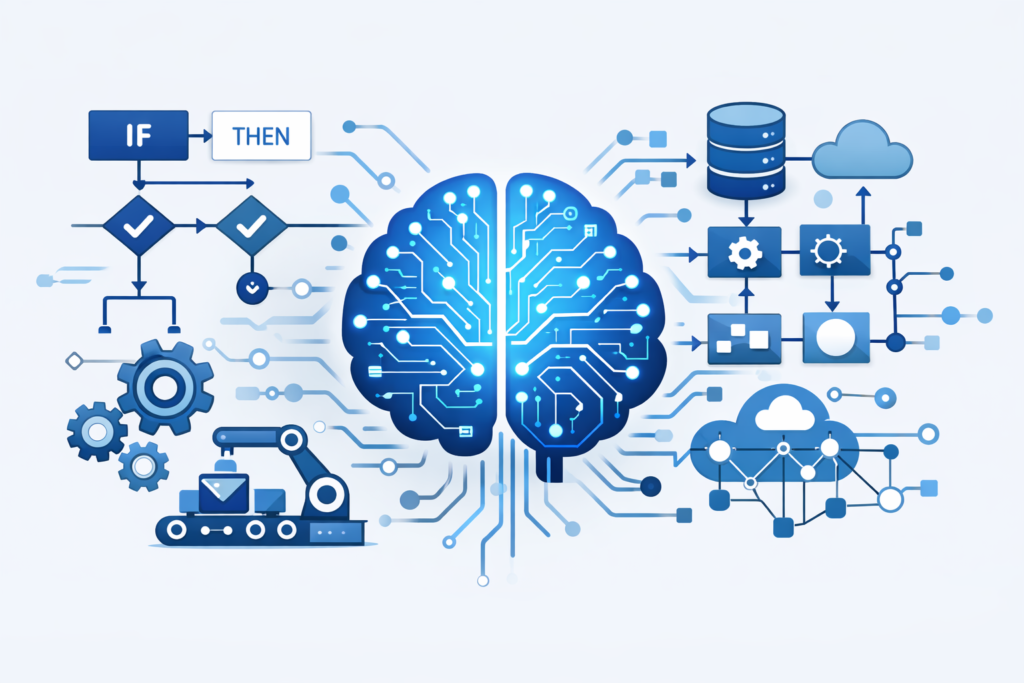
Artificial Intelligence (AI) is the broad concept of machines being able to perform tasks that normally require human intelligence — like thinking, reasoning, problem-solving, decision-making, and learning.
The key thing most people miss is this 👇
👉 AI doesn’t always mean “learning from data.”
AI can exist with or without machine learning.
Simple definition (keep this snippet-worthy):
Artificial Intelligence is the science of making machines act intelligently, either by following rules or by learning from data.
Real-world AI examples (not all use ML)
- Rule-based chatbots that reply using predefined scripts
- Chess engines that follow programmed strategies
- Recommendation systems based on fixed logic
- Spam filters using predefined rules
All of these are AI, but not necessarily Machine Learning.
Types of Artificial Intelligence
To really understand AI, you need to know its two main types:
1️⃣ Narrow AI (Weak AI)
This is the only AI that exists today.
- Designed for one specific task
- Cannot think outside its training or rules
- Examples:
- Google Search
- Voice assistants
- Face recognition systems
- Recommendation engines
👉 Every AI tool you use today falls under Narrow AI.
2️⃣ General AI (Strong AI)
- Hypothetical
- Would think, learn, and reason like a human
- Can solve any intellectual task
- Does not exist yet
So when people talk about AI taking over the world — they’re talking about something that hasn’t been built.
Important takeaway
- AI is the goal → making machines intelligent
- ML and DL are methods → how machines achieve intelligence
Think of it like this:
AI is the destination.
Machine Learning and Deep Learning are the roads that take you there.
What Is Machine Learning (ML)?
Machine Learning (ML) is a subset of Artificial Intelligence that allows machines to learn from data instead of being explicitly programmed.
In simple words 👇
👉 ML teaches machines to improve automatically through experience.
Instead of writing hundreds of rules like:
“If this happens, do that”
You give the system data, and it figures out the patterns on its own.
Simple definition (snippet-ready)
Machine Learning is a way for computers to learn from data and make predictions or decisions without being manually programmed for every scenario.
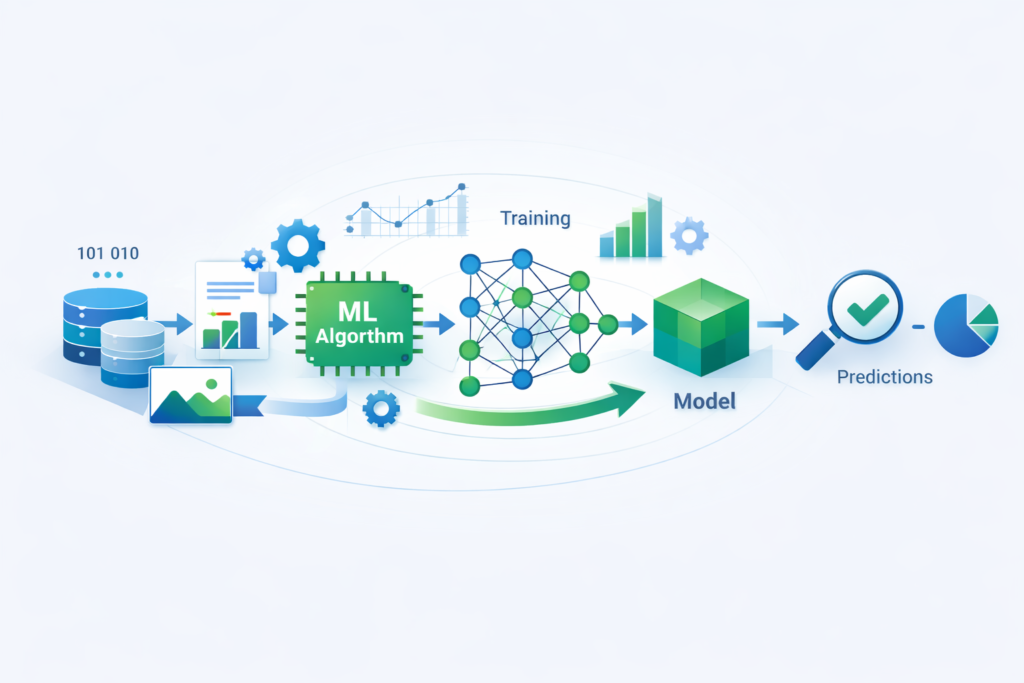
How Machine Learning Actually Works (Simple Flow)
Here’s the basic ML process:
- You provide data (past examples)
- The algorithm finds patterns
- It creates a model
- The model makes predictions on new data
- The system improves as more data is added
Example:
- Past data: house size, location, price
- ML model learns patterns
- Predicts price of a new house
No fixed rules. Just learning from data.
Types of Machine Learning (Very Important for SEO + Understanding)
1️⃣ Supervised Learning
- Works with labeled data
- You already know the correct answers
- Common use cases:
- Email spam detection
- Price prediction
- Credit scoring
Example:
Emails labeled as spam or not spam → model learns to classify future emails.
2️⃣ Unsupervised Learning
- Works with unlabeled data
- Finds hidden patterns or groups
- Common use cases:
- Customer segmentation
- Market research
- Behavior analysis
Example:
Grouping customers based on shopping behavior without predefined categories.
3️⃣ Reinforcement Learning
- Learns by trial and error
- Rewards good actions, penalizes bad ones
- Common use cases:
- Game-playing AI
- Robotics
- Recommendation engines
Example:
An AI agent learns to win a game by maximizing rewards over time.
Popular Machine Learning Algorithms (Non-Technical)
You don’t need to be a data scientist to get this:
- Linear Regression → predicts numbers
- Logistic Regression → yes/no decisions
- Decision Trees → rule-like decisions
- Random Forest → multiple trees combined
- Support Vector Machines → complex classifications
These models are:
- Faster to train
- Easier to explain
- Cheaper to run than Deep Learning
Key Limitation of Machine Learning
Here’s the catch 👇
- ML depends heavily on feature engineering
- Humans must decide what data matters
- Struggles with unstructured data like:
- Images
- Audio
- Free-form text
And that limitation is exactly why Deep Learning exists.
Quick takeaway
- AI = overall intelligence goal
- Machine Learning = learning from data
- ML works great when:
- Data is structured
- Explainability matters
- Budget and compute are limited
What Is Deep Learning (DL)?
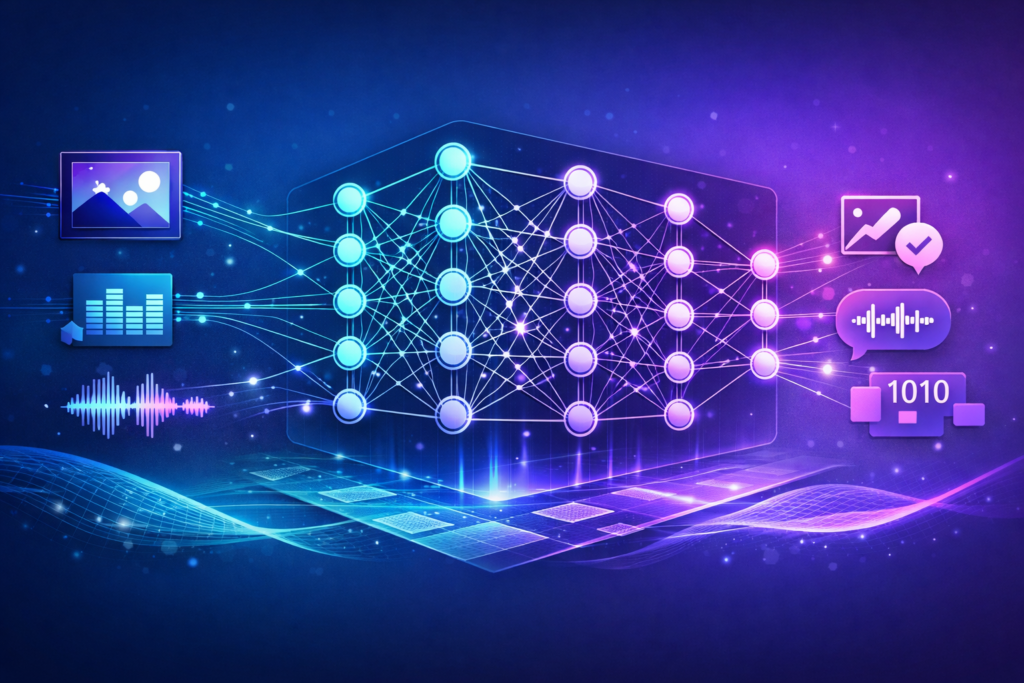
Deep Learning (DL) is a specialized subset of Machine Learning that uses artificial neural networks to learn from massive amounts of data.
In simple terms 👇
👉 Deep Learning teaches machines to learn the way the human brain works — using layers of neurons.
That’s why it’s called deep learning:
because the model has multiple layers that process data step by step.
Simple Definition (Snippet-Ready)
Deep Learning is a type of machine learning that uses multi-layer neural networks to automatically learn complex patterns from large datasets.
How Deep Learning Works (Easy Breakdown)
Instead of manually telling the system what features matter, deep learning figures it out on its own.
Example: Image recognition 👇
- First layer → detects edges
- Second layer → detects shapes
- Third layer → detects objects
- Final layer → identifies the image
No human-written rules. No manual feature selection.
Why Deep Learning Is So Powerful
Deep Learning shines when dealing with unstructured data, such as:
- Images
- Videos
- Audio
- Natural language text
That’s why DL powers:
- Face recognition
- Voice assistants
- Self-driving cars
- Language translation
- Chatbots like ChatGPT
Traditional ML struggles here. Deep Learning dominates.
Common Types of Deep Learning Models (Non-Technical)
You don’t need to memorize formulas — just understand the use cases:
🧠 Neural Networks (ANN)
- Base structure
- Used for simple deep learning tasks
👁️ Convolutional Neural Networks (CNN)
- Designed for images & videos
- Used in:
- Facial recognition
- Medical imaging
- Object detection
🗣️ Recurrent Neural Networks (RNN)
- Works with sequences
- Used for:
- Speech recognition
- Time-series prediction
🔁 Transformers (Modern Standard)
- Power today’s generative AI
- Used in:
- Chatbots
- Translation tools
- Large Language Models (LLMs)
Trade-offs of Deep Learning (The Real Talk)
Deep Learning is powerful — but not always the best choice.
Pros
- Extremely high accuracy
- Learns features automatically
- Best for complex, real-world data
Cons
- Needs huge datasets
- Requires high computing power (GPUs)
- Expensive to train
- Harder to explain (black-box models)
Quick takeaway
- Deep Learning = advanced Machine Learning
- Best for:
- Images, speech, and text
- Large-scale problems
- High-accuracy needs
- Not ideal when:
- Data is limited
- Explainability is critical
- Budget is tight
AI vs Machine Learning vs Deep Learning (Side-by-Side Comparison)
Below is the simplest and most accurate comparison you’ll find anywhere. If someone scrolls only once on your blog, this section alone can satisfy the search intent — that’s exactly why Google loves it.
| Factor | Artificial Intelligence (AI) | Machine Learning (ML) | Deep Learning (DL) |
|---|---|---|---|
| Definition | Broad concept of making machines intelligent | Subset of AI that learns from data | Subset of ML using neural networks |
| Relationship | Parent category | Child of AI | Child of ML |
| Learning Required | Not always | Yes | Yes (automatically) |
| Data Dependency | Low to high | Medium to high | Very high |
| Feature Engineering | Manual or rule-based | Mostly manual | Fully automatic |
| Handles Unstructured Data | Limited | Struggles | Excellent |
| Accuracy Level | Depends on rules | High | Very high |
| Explainability | Easy to explain | Moderate | Difficult (black box) |
| Compute Requirement | Low | Medium | Very high (GPUs) |
| Cost | Low to medium | Medium | High |
| Speed to Deploy | Fast | Moderate | Slow |
| Best For | Rule-based systems | Predictions & patterns | Complex real-world problems |
One-Line Explanation
- AI → Makes machines intelligent
- ML → Lets machines learn from data
- DL → Lets machines learn like a human brain
If Google pulls just this — you still win the click.
Real-Life Analogy (Human Brain Hack 🧠)
Think of it like this:
- AI is the idea of building a smart student
- Machine Learning is teaching the student with examples
- Deep Learning is the student teaching themselves by observing everything
Same goal. Different levels of intelligence.
Which One Should You Choose? (Quick Decision Logic)
Use this cheat code 👇
- Choose AI when:
- Rules are clear
- Decisions are simple
- Speed matters more than learning
- Choose Machine Learning when:
- You have structured data
- Predictions are needed
- Explainability is important
- Choose Deep Learning when:
- Data is huge
- Problem is complex
- Accuracy is critical
- Budget + compute are available
When to Use Machine Learning vs Deep Learning (Decision Guide)
One of the biggest mistakes businesses and beginners make is jumping straight to Deep Learning just because it sounds advanced.
Reality check 👇
👉 More complex doesn’t always mean better.
The right choice depends on data size, cost, speed, and explainability.
Choose Machine Learning When 👇
Machine Learning is the smarter option if:
- Your data is structured (numbers, categories, tables)
- You have limited data (thousands, not millions)
- You need fast results
- Model decisions must be explainable
- Budget or computing power is limited
Example use cases:
- Sales forecasting
- Credit scoring
- Customer churn prediction
- Email spam classification
- Pricing optimization
In these cases, traditional ML models often perform almost as well as deep learning, at a fraction of the cost.
Choose Deep Learning When 👇
Deep Learning is the right choice if:
- You’re working with images, audio, video, or text
- You have massive datasets
- The problem is highly complex
- Accuracy matters more than explainability
- You can afford GPUs and longer training time
Example use cases:
- Face recognition
- Speech-to-text systems
- Language translation
- Self-driving vehicles
- Chatbots and virtual assistants
Deep Learning excels where manual feature engineering becomes impossible.
Quick Decision Checklist (Bookmark This)
Ask yourself these 5 questions:
1️⃣ Is my data structured or unstructured?
2️⃣ How much data do I actually have?
3️⃣ Do I need to explain the model’s decision?
4️⃣ What’s my budget and compute power?
5️⃣ Is speed or accuracy more important?
Decision shortcut:
- Structured data + low budget → Machine Learning
- Unstructured data + high complexity → Deep Learning
Common Myth (That Hurts Performance)
❌ “Deep Learning is always better than Machine Learning”
Truth 👇
In many business problems, well-tuned ML models outperform poorly trained deep learning models — faster, cheaper, and more reliable.
Key takeaway
- Machine Learning = efficient, explainable, cost-effective
- Deep Learning = powerful, accurate, data-hungry
Choosing correctly saves:
- Time
- Money
- Infrastructure cost
- Engineering effort
Real-World Examples: AI vs Machine Learning vs Deep Learning in Action
To really lock this topic in your head (and Google’s), let’s see how AI, ML, and Deep Learning are actually used in the real world — not theory, just practical applications.
1️⃣ Artificial Intelligence (AI) Examples
These systems are intelligent, but don’t always learn from data.
Example: Rule-Based Chatbots
- Follow predefined scripts
- Respond based on keywords
- No learning involved
Used in:
- Customer support FAQs
- IVR call systems
- Simple website chat widgets
👉 This is AI, but not Machine Learning.
Example: Game AI (Early Chess Programs)
- Uses logic, rules, and strategies
- No data-driven learning
Still classified as Artificial Intelligence.
2️⃣ Machine Learning (ML) Examples
These systems learn from historical data and improve over time.
Example: Email Spam Detection
- Learns patterns from spam vs non-spam emails
- Improves as more emails are processed
Used by:
- Gmail
- Outlook
- Yahoo Mail
Example: Product Recommendation Systems
- Analyzes user behavior
- Suggests relevant products
Used by:
- Amazon
- Netflix
- E-commerce platforms
👉 Structured data + predictions = Machine Learning sweet spot.
3️⃣ Deep Learning (DL) Examples
This is where modern AI breakthroughs happen.
Example: Image Recognition
- Identifies faces, objects, and scenes
- Learns features automatically
Used in:
- Face unlock on smartphones
- Medical imaging
- Surveillance systems
Example: Voice Assistants
- Converts speech to text
- Understands intent
- Responds naturally
Used by:
- Siri
- Google Assistant
- Alexa
Example: Chatbots & Generative AI
- Understand natural language
- Generate human-like responses
Used in:
- Customer support automation
- Content generation
- AI-powered assistants
👉 Large data + neural networks = Deep Learning dominance.
Industry-Wise Breakdown (Quick Scan)
| Industry | AI | ML | Deep Learning |
|---|---|---|---|
| Healthcare | Rule-based alerts | Disease prediction | Medical imaging |
| Finance | Fraud rules | Credit scoring | Risk modeling |
| E-commerce | Search filters | Product recommendations | Visual search |
| Automotive | Decision logic | Sensor data analysis | Self-driving systems |
| Marketing | Automation tools | Audience targeting | Personalization engines |
Why This Matters for You
Understanding which technology fits which problem helps you:
- Avoid overengineering
- Reduce costs
- Improve accuracy
- Make smarter tech decisions
Advantages and Disadvantages of AI, Machine Learning, and Deep Learning
No hype here. Every technology has strengths and trade-offs. Understanding this helps users (and Google) see your content as honest, authoritative, and decision-driven.
Artificial Intelligence (AI)
✅ Advantages
- Easy to design for simple tasks
- Works well with rule-based systems
- Low cost and fast deployment
- No need for large datasets
❌ Disadvantages
- Cannot improve on its own
- Limited to predefined logic
- Fails in complex or changing environments
👉 Best when problems are clearly defined.
Machine Learning (ML)
✅ Advantages
- Learns from data automatically
- High accuracy for structured data
- Faster and cheaper than deep learning
- Easier to explain than neural networks
❌ Disadvantages
- Requires manual feature engineering
- Performance depends heavily on data quality
- Struggles with images, audio, and free text
👉 Best balance between performance and cost.
Deep Learning (DL)
✅ Advantages
- Exceptional accuracy
- Handles unstructured data extremely well
- Learns features automatically
- Powers modern AI systems
❌ Disadvantages
- Requires massive datasets
- Needs powerful hardware (GPUs)
- Expensive and time-consuming to train
- Difficult to interpret (black-box models)
👉 Best when accuracy > cost.
Quick Comparison (Decision Snapshot)
- AI → Simple logic, fast results
- ML → Smart predictions, structured data
- DL → Complex intelligence, massive scale
The Hidden Cost Most People Ignore
Deep Learning isn’t just about accuracy — it also costs:
- More infrastructure
- More training time
- More engineering effort
That’s why many real-world systems still rely on Machine Learning instead of Deep Learning.
Data, Cost & Compute: How Expensive Are AI, ML, and Deep Learning?
When people compare AI vs Machine Learning vs Deep Learning, they usually focus on accuracy.
But in the real world, cost, data availability, and computing power decide everything.
Here’s the honest breakdown 👇
Artificial Intelligence (AI): Lowest Cost
Data Requirement
- Very low
- Can work with rules and logic
- No historical data needed
Compute Requirement
- Minimal
- Runs easily on standard servers or even local machines
Cost Reality
- Cheap to build
- Cheap to maintain
- Fast to deploy
👉 That’s why rule-based AI is still used in:
- Customer support
- Automation tools
- Simple decision systems
Machine Learning (ML): Balanced Cost
Data Requirement
- Medium
- Works best with thousands to hundreds of thousands of data points
- Needs clean, structured data
Compute Requirement
- Moderate
- Can run on CPUs or basic cloud infrastructure
Cost Reality
- Affordable for most businesses
- Faster ROI compared to deep learning
- Lower ongoing costs
👉 This is why most business AI systems today are powered by ML, not deep learning.
Deep Learning (DL): Highest Cost
Data Requirement
- Very high
- Often needs millions of data points
- Data labeling itself can be expensive
Compute Requirement
- Very high
- Requires:
- GPUs
- Specialized hardware
- Cloud-based infrastructure
Cost Reality
- Expensive to train
- Higher inference costs
- Longer development cycles
👉 Deep Learning is powerful, but it’s not budget-friendly unless the use case truly demands it.
Cost Comparison Snapshot
| Factor | AI | ML | Deep Learning |
|---|---|---|---|
| Data Needed | Very Low | Medium | Very High |
| Hardware | Basic | CPU / Cloud | GPU / Cloud |
| Training Time | Minimal | Moderate | Very High |
| Deployment Cost | Low | Medium | High |
| Maintenance Cost | Low | Medium | High |
The Smart Strategy Most Companies Use
Instead of jumping straight to deep learning, smart teams:
- Start with rule-based AI
- Upgrade to Machine Learning
- Move to Deep Learning only if needed
This approach:
- Saves money
- Reduces risk
- Delivers faster results
Key takeaway
- AI → cheapest, fastest
- ML → best ROI for most use cases
- DL → expensive but unmatched power
Explainability, Ethics & Trust: Why ML Is Often Preferred Over Deep Learning
As AI systems become more powerful, a new problem shows up 👇
👉 Can we trust what the model is doing?
This is where explainability and ethics matter — especially in industries like finance, healthcare, hiring, and law.
What Is Explainability in AI?
Explainability means:
- Understanding why a model made a decision
- Being able to justify predictions to humans
- Auditing and improving the system when something goes wrong
Not all AI models are equally explainable.
Explainability: AI vs ML vs Deep Learning
Artificial Intelligence (Rule-Based)
- Fully transparent
- Easy to trace decisions
- Every rule is human-written
👉 Highest explainability, lowest intelligence.
Machine Learning
- Partially explainable
- Models like decision trees and linear regression are easy to interpret
- Even complex ML models can be explained with tools
👉 Best balance between accuracy and trust.
Deep Learning
- Very hard to explain
- Decisions happen across millions of parameters
- Often called a “black box”
👉 You get accuracy, but lose transparency.
Why This Matters in the Real World
Some industries cannot afford black-box decisions.
Examples:
- Bank loans → Why was the loan rejected?
- Healthcare → Why was a diagnosis predicted?
- Hiring systems → Why was a candidate filtered out?
- Legal systems → Can this decision be defended in court?
In these cases, Machine Learning often beats Deep Learning, even if accuracy is slightly lower.
Ethics & Bias: The Hidden Risk
AI systems learn from data — and data can be biased.
Risks include:
- Gender bias
- Racial bias
- Economic bias
Deep Learning models can amplify these biases because:
- They use massive datasets
- Patterns are harder to audit
That’s why many organizations:
- Prefer simpler ML models
- Use explainability tools
- Regularly audit predictions
The Practical Industry Rule
- Need transparency + compliance → Machine Learning
- Need extreme accuracy + scale → Deep Learning
- Need fast automation → AI (rule-based)
Key takeaway
The smartest AI systems aren’t just accurate — they’re trustworthy, explainable, and fair.
Career Paths & Skills: AI vs Machine Learning vs Deep Learning
If you’re wondering what to learn, where to start, or which path actually pays, this section answers it cleanly.
Spoiler: you don’t need to jump straight into Deep Learning.
Career Path 1: Artificial Intelligence (AI)
Who this is for
- Beginners
- Automation-focused roles
- Product managers
- Business analysts
- Non-technical professionals
Skills needed
- Logical thinking
- Basic programming
- Workflow automation
- Rule-based systems
- Problem-solving mindset
Common roles
- AI Analyst
- Automation Engineer
- Product Manager (AI tools)
👉 Best starting point if you want to understand AI concepts without heavy math.
Career Path 2: Machine Learning (ML)
Who this is for
- Students
- Engineers
- Data analysts
- SEO & marketing professionals moving into AI
- Business owners building prediction systems
Skills needed
- Python
- Statistics & probability
- Data analysis
- Machine learning algorithms
- Model evaluation
Common roles
- Machine Learning Engineer
- Data Scientist
- Applied AI Engineer
👉 Most in-demand and practical career path today.
This is where:
- Real jobs exist
- Businesses actually hire
- ROI is highest
Career Path 3: Deep Learning (DL)
Who this is for
- Advanced engineers
- Researchers
- AI specialists
- People targeting high-paying AI roles
Skills needed
- Neural networks
- Linear algebra
- GPUs & cloud computing
- Deep learning frameworks
- Large-scale data handling
Common roles
- Deep Learning Engineer
- AI Researcher
- Computer Vision / NLP Engineer
👉 High salaries, but high entry barrier.
Smart Learning Roadmap (Recommended)
Here’s the industry-proven path 👇
1️⃣ Learn AI basics
2️⃣ Master Machine Learning
3️⃣ Specialize in Deep Learning (optional)
Skipping steps usually leads to confusion and burnout.
Salary Reality (High-Level Insight)
- AI / Automation → Entry to mid-level
- Machine Learning → Strong demand + stable growth
- Deep Learning → High-paying but fewer roles
👉 ML skills open more doors than DL alone.
Key takeaway
- Start with AI
- Build depth in Machine Learning
- Move to Deep Learning only if your goals demand it
Frequently Asked Questions (FAQs)
1. What is the main difference between AI and Machine Learning?
AI is the broad concept of making machines intelligent, while Machine Learning is a method that allows machines to learn from data without explicit programming.
2. Is Deep Learning part of Machine Learning?
Yes. Deep Learning is a subset of Machine Learning that uses neural networks with multiple layers to learn complex patterns.
3. Is Deep Learning always better than Machine Learning?
No. Deep Learning needs massive data and compute. For many structured problems, Machine Learning performs just as well at lower cost.
4. Can AI exist without Machine Learning?
Yes. Rule-based systems and logic-driven programs are AI but do not use Machine Learning.
5. Which is easier to learn: ML or DL?
Machine Learning is easier to start with. Deep Learning requires stronger math and computing knowledge.
6. Do I need coding to learn AI?
Basic AI concepts can be learned without coding, but ML and DL require programming skills.
7. Which industries use Deep Learning the most?
Healthcare, autonomous vehicles, speech recognition, computer vision, and generative AI platforms.
8. Is Machine Learning enough for a good career?
Yes. Machine Learning is one of the most in-demand and practical AI skills today.
9. Why is Deep Learning expensive?
Because it needs large datasets, GPUs, long training time, and complex infrastructure.
10. What should beginners learn first: AI, ML, or DL?
Beginners should start with AI basics, then move to Machine Learning, and only then consider Deep Learning.
Final Conclusion: AI vs Machine Learning vs Deep Learning
Artificial Intelligence is the vision, Machine Learning is the engine, and Deep Learning is the turbocharger.
Understanding the difference helps you:
- Make better tech decisions
- Choose the right career path
- Save time, money, and effort
There’s no single “best” technology — only the right tool for the right problem.