Generative AI is no longer just a tech buzzword—it’s quickly becoming part of everyday life. From writing content and generating images to helping businesses automate tasks, people across the USA are searching to understand the generative AI meaning, how it actually works, and.

where it’s being used in the real world. If you’ve seen AI tools creating text, images, or even code in seconds and wondered “what is generative AI and how does it do this?”, you’re not alone.
Simply put, generative AI is a type of artificial intelligence designed to create new content instead of just analyzing existing data.
Unlike traditional AI systems that follow fixed rules, generative AI learns patterns from massive datasets and produces original outputs. That’s why searches like generative AI explained, generative AI examples, and generative AI uses are growing fast—especially among professionals, students, and business owners.
In this guide, we’ll break down the meaning of generative AI, explain how generative AI works step by step, and explore practical use cases without technical fluff or hype.
What Is Generative AI? (Simple Explanation)
Generative AI is a branch of artificial intelligence that focuses on creating new content instead of just analyzing or classifying existing data. When people search for generative AI meaning, they’re usually trying to understand one simple thing: how can a machine create text, images, videos, or code that feels human-made?
In simple terms, generative AI works by learning patterns from massive amounts of data—such as text, images, or audio—and then using those patterns to generate something new. This is why generative AI can write articles, design images, compose music, or even generate software code that didn’t exist before.
To explain generative AI even more clearly:
- Traditional AI answers questions or makes predictions.
- Generative AI creates content based on what it has learned.
That’s the core difference.
For example, when you type a prompt into a generative AI tool and it produces a paragraph, an image, or a response, it’s not copying content word-for-word. Instead, it’s predicting what the most relevant and natural output should be based on patterns it learned during training. This is why searches like generative AI explained and what is generative AI are so common—people want clarity, not technical jargon.
In short, the meaning of generative AI comes down to this:
👉 AI that generates original content using learned data patterns, not fixed rules.
Also Read:
Beauty Salon Marketing Strategies: SEO, Organic & Ayurvedic Tips (2025)
How Does Generative AI Work? (Step-by-Step)
To really understand the generative AI meaning, you need to know how generative AI works behind the scenes. The good news? You don’t need a technical background to get it. The process is logical, not magical.
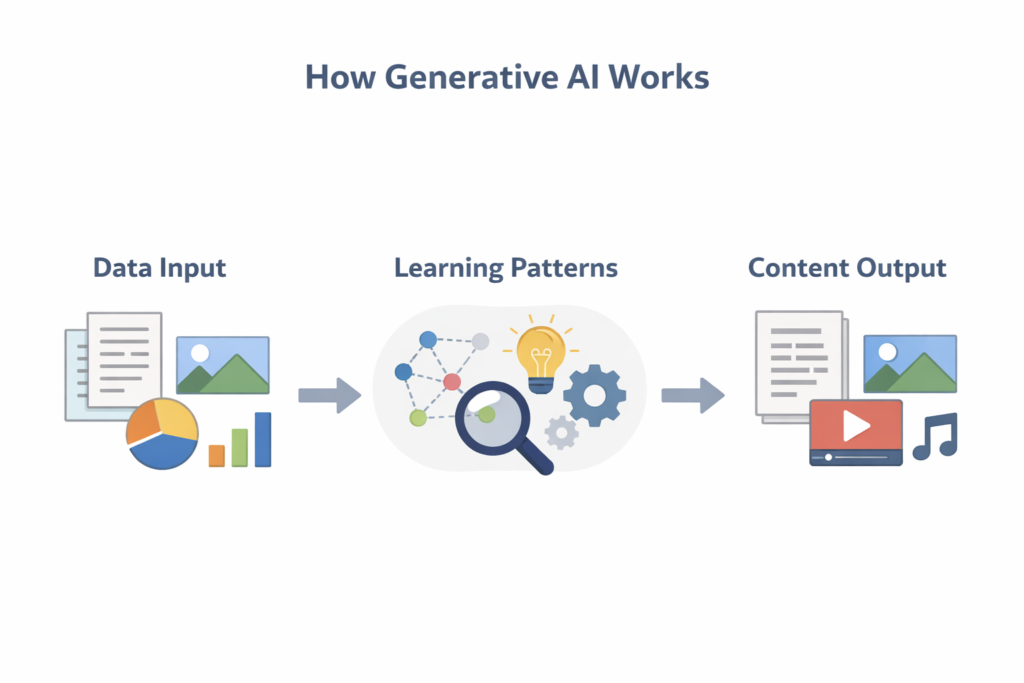
Here’s a simple step-by-step breakdown of how generative AI works:
1️⃣ Training on Massive Data
Generative AI systems are trained on huge datasets that include text, images, audio, or code. This data helps the model understand patterns, structure, tone, and context. For example, when learning language, generative AI studies how words, sentences, and paragraphs naturally flow.
This training phase is the foundation of all generative AI examples you see today.
2️⃣ Learning Patterns, Not Memorization
A common misconception is that generative AI copies content. It doesn’t. Instead, it learns patterns and probabilities.
- Which words usually appear together
- How sentences are structured
- How ideas logically connect
This is why generative AI explained properly means understanding that it predicts the next best output, not stored answers.
3️⃣ User Input (Prompt)
When a user enters a prompt, the generative AI analyzes it for:
- Intent
- Context
- Language patterns
This step is critical because the quality of output depends heavily on the quality of input. That’s why prompts matter so much when using generative AI tools.
4️⃣ Content Generation
Based on everything it has learned, the system generates new content in real time. This could be:
- Text responses
- Images
- Code
- Audio or video
This is where generative AI uses become visible in real-world applications like content creation, marketing, and software development.
5️⃣ Continuous Improvement
Many generative AI systems improve over time through updates, feedback, and better datasets. This is why results today are far more accurate than early versions—and why interest in how generative AI works keeps growing in the USA.
In simple terms, generative AI works by learning from data, understanding patterns, responding to user input, and generating new outputs—all in seconds.
Generative AI vs Traditional AI (Key Differences)
A lot of people searching for generative AI meaning also want to know one thing clearly:
How is generative AI different from traditional AI?
This comparison matters because most people have already interacted with traditional AI for years—recommendation systems, spam filters, or voice assistants. Generative AI is a different game.
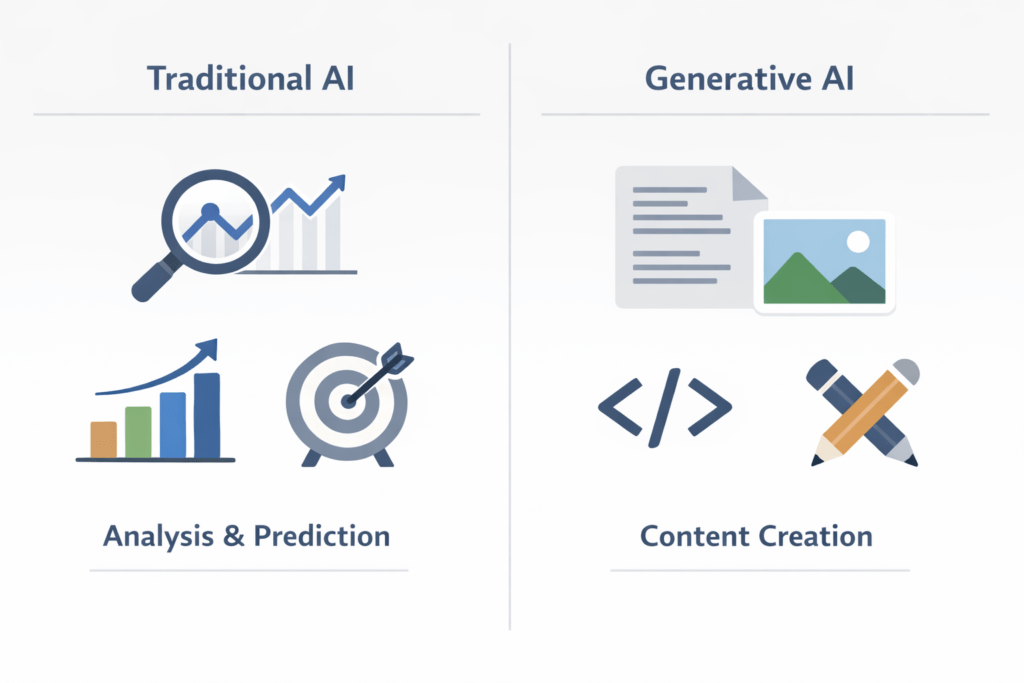
Here’s the difference explained in plain English.
🔹 Purpose
- Traditional AI is designed to analyze, classify, or predict based on existing data.
- Generative AI is designed to create new content—text, images, code, audio, or video.
That’s why searches like generative AI explained are exploding. Creation is the shift.
🔹 Output Type
- Traditional AI gives you:
- Yes / No answers
- Predictions
- Recommendations
- Generative AI gives you:
- Written content
- Visual designs
- Code snippets
- Human-like responses
This is where most real-world generative AI examples come from
🔹 Flexibility
Traditional AI follows predefined rules or trained decision paths.
Generative AI works with probabilities and patterns, allowing it to adapt to different prompts and contexts.
That flexibility is why generative AI uses are expanding so fast across industries.
🔹 Learning Style
- Traditional AI: Learns to recognize patterns and label data.
- Generative AI: Learns patterns and uses them to generate something new.
This is a core part of understanding how generative AI works.
🔹 Simple Comparison Table (Conceptual)
- Traditional AI → “Analyze this data.”
- Generative AI → “Create something new from this idea.”
That single line explains the entire difference.
In short, traditional AI supports decisions, while generative AI drives creation. That’s why businesses, creators, and professionals are shifting focus toward generative AI instead of older AI systems.
Popular Generative AI Examples (Real-World)
When users search for generative AI examples, they’re not interested in theory. They want to know what generative AI actually does in real life and where they might already be using it without realizing.
Here are the most common and practical generative AI examples you’ll see today, especially in the USA.
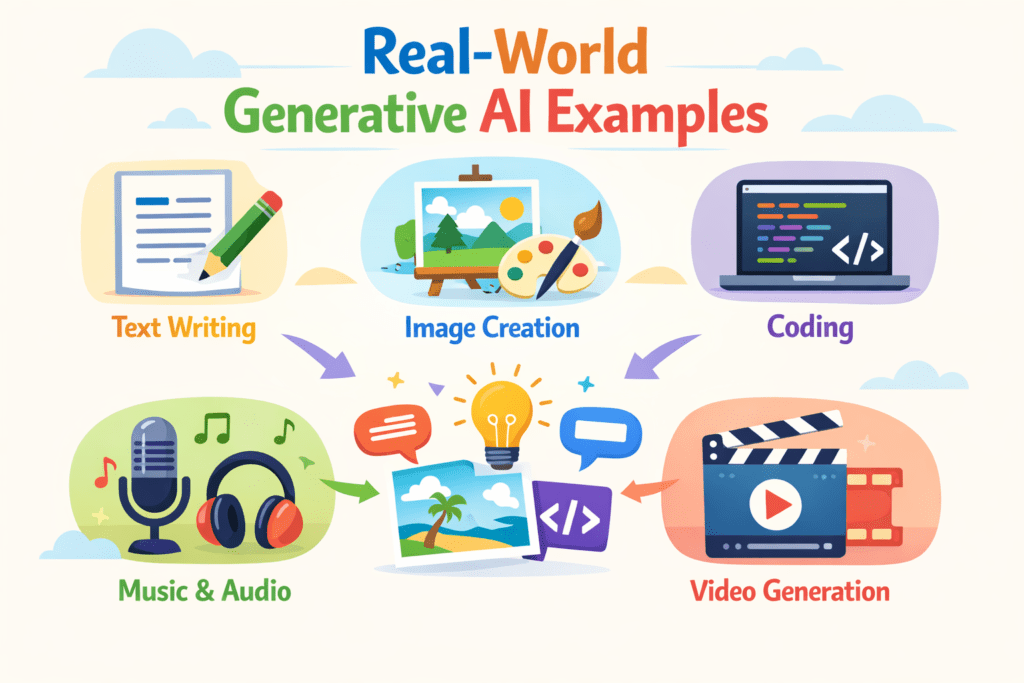
1️⃣ Text Generation
Text-based generative AI can create:
- Articles and blog posts
- Emails and marketing copy
- Product descriptions
- Chat-style responses
This is one of the most widely adopted generative AI uses, especially in content creation, customer support, and education. Instead of just correcting grammar or analyzing text, generative AI produces entirely new written content based on user prompts.
2️⃣ Image Generation
Generative AI can create images from text descriptions.
For example, you describe an idea, and the AI generates a visual representation of it.
This use case is popular in:
- Design and branding
- Advertising
- Social media content
- Product mockups
These generative AI examples are a big reason why creatives are paying attention to AI—not because it replaces creativity, but because it speeds it up.
3️⃣ Code Generation
In software development, generative AI is used to:
- Write code snippets
- Suggest functions
- Debug errors
- Explain existing code
This is a strong example of how generative AI works in technical fields without requiring users to be experts themselves.
4️⃣ Audio and Voice Generation
Generative AI can also produce:
- Voiceovers
- Audio narration
- Music compositions
This expands generative AI uses into podcasts, videos, gaming, and accessibility tools.
5️⃣ Video Generation (Emerging Use Case)
Video-based generative AI is still evolving, but it’s already being used for:
- Short marketing videos
- Educational clips
- Automated presentations
This area is growing fast and is often searched alongside generative AI explained queries.
In simple terms, generative AI examples show one thing clearly:
👉 It doesn’t just assist—it creates.
That’s why adoption across industries keeps accelerating.
Common Uses of Generative AI Today
Understanding generative AI uses is where most users finally connect the dots. Once the generative AI meaning is clear, the next question is always the same: “Where is this actually being used right now?”
Here are the most common and practical uses of generative AI today.
1️⃣ Content Creation and Writing
One of the biggest generative AI uses is content creation. Businesses and individuals use generative AI to:
- Draft blog posts
- Write emails
- Create social media captions
- Generate product descriptions
This doesn’t replace human strategy, but it drastically speeds up the writing process. That’s why searches for generative AI explained often come from marketers and creators.
2️⃣ Marketing and Advertising
In marketing, generative AI is used to:
- Create ad copy
- Test multiple message variations
- Personalize marketing content
This use case directly ties generative AI to business growth, which is why adoption in the USA is accelerating.
3️⃣ Customer Support and Chatbots
Generative AI powers modern chatbots that:
- Answer customer questions
- Provide 24/7 support
- Handle common issues automatically
Unlike traditional chatbots, these systems can generate natural, context-aware responses—another clear example of how generative AI works in real-world scenarios.
4️⃣ Education and Learning
In education, generative AI is used to:
- Explain complex topics
- Generate practice questions
- Summarize long content
This is why students often search for generative AI explained in simple terms.
5️⃣ Software Development
Developers use generative AI to:
- Write and review code
- Debug issues
- Learn new programming concepts faster
This is one of the strongest generative AI examples showing productivity gains.
6️⃣ Design and Creative Work
Generative AI helps designers by:
- Creating visual concepts
- Generating layouts
- Speeding up brainstorming
This use case proves that generative AI supports creativity rather than replacing it.
Overall, generative AI uses are growing because the technology saves time, reduces cost, and increases output across industries.
Generative AI in Business (Why Companies Care)
For businesses, generative AI isn’t about trends or experiments—it’s about efficiency, speed, and scale. Once the generative AI meaning is clear, companies start asking a more serious question: how does this actually help the business make or save money?
This is why generative AI uses in business are expanding fast, especially in the USA.
Faster Productivity at Lower Cost
Generative AI allows teams to produce more work in less time. Tasks that once took hours—like drafting content, creating reports, or brainstorming ideas—can now be done in minutes. This directly improves productivity without increasing headcount.
That’s a big reason why generative AI explained often appears in business and startup discussions.
Better Decision Support
By generating summaries, insights, and drafts, generative AI helps decision-makers process information faster. While it doesn’t replace human judgment, it reduces mental load and speeds up analysis.
This is another practical example of how generative AI works inside modern organizations.
Scalable Customer Engagement
Businesses use generative AI to personalize communication at scale. Whether it’s customer support responses, onboarding emails, or marketing messages, generative AI makes it possible to engage thousands of users without writing everything manually.
This is one of the most valuable generative AI examples for growing companies.
Innovation Without Heavy Investment
Generative AI lowers the barrier to experimentation. Businesses can test ideas, prototypes, and campaigns quickly—without investing heavily in resources upfront.
That’s why many companies see generative AI as a competitive advantage, not just a productivity tool.
In short, businesses care about generative AI because it helps them move faster, operate smarter, and scale without friction.
Benefits of Generative AI
Once people understand the generative AI meaning and see real generative AI examples, the next logical question is: what are the actual benefits of generative AI?
Here are the advantages that matter in real-world usage, not theory.
1️⃣ Speed and Efficiency
One of the biggest benefits of generative AI is speed. Tasks that normally take hours—writing content, creating designs, summarizing information—can be done in minutes. This is a clear reason why generative AI uses are growing across industries.
2️⃣ Increased Productivity
Generative AI helps individuals and teams get more done without increasing workload. By handling repetitive or time-consuming tasks, it frees people to focus on strategy, creativity, and decision-making.
This productivity boost explains why searches like generative AI explained are so common among professionals.
3️⃣ Cost Reduction
By automating parts of workflows, generative AI reduces operational costs. Businesses can scale output without hiring large teams, making it a cost-effective solution for growth.
This is one of the most attractive generative AI benefits for companies.
4️⃣ Creativity Support
Generative AI doesn’t replace creativity—it enhances it. It helps generate ideas, drafts, and concepts that humans can refine. This is why designers, writers, and marketers are adopting generative AI instead of avoiding it.
5️⃣ Scalability
Generative AI allows systems to handle increasing workloads without performance loss. Whether it’s customer interactions or content production, this scalability is a major reason behind widespread adoption.
Overall, the benefits of generative AI come down to one thing:
👉 more output, less friction, better efficiency.
Limitations and Risks of Generative AI
Even though the generative AI meaning and its benefits sound impressive, it’s important to understand the limitations and risks of generative AI. This is exactly what many users in the USA search for before fully trusting or adopting the technology.
Generative AI is powerful—but it’s not perfect.
1️⃣ Accuracy Issues
Generative AI can sometimes produce information that sounds correct but isn’t fully accurate. Because it generates content based on patterns, not real-time understanding, mistakes can happen—especially with complex or sensitive topics.
This is why blindly trusting generative AI examples without verification can be risky.
2️⃣ Bias in Outputs
Since generative AI models are trained on existing data, they can inherit biases present in that data. This may lead to skewed or unfair outputs if not carefully managed.
Understanding this risk is a key part of generative AI explained responsibly.
3️⃣ Over-Reliance on AI
One major concern with growing generative AI uses is over-dependence. When users rely too heavily on AI-generated content without human review, quality and originality can suffer.
Generative AI should support human work—not replace critical thinking.
4️⃣ Data Privacy Concerns
Some generative AI systems require user inputs that may include sensitive information. If data handling policies aren’t clear, privacy risks can arise.
This is why businesses must evaluate tools carefully before adoption.
5️⃣ Lack of True Understanding
Despite sounding intelligent, generative AI doesn’t actually “understand” content the way humans do. It predicts outputs based on probability, which limits its judgment and reasoning abilities.
This limitation is central to understanding how generative AI works realistically.
In short, generative AI offers massive potential—but only when used carefully, ethically, and with human oversight.
Is Generative AI Replacing Jobs or Creating New Ones?
This is one of the most searched questions around generative AI meaning, especially in the USA. As generative AI uses expand across industries, people naturally worry about jobs, careers, and long-term impact.
So let’s keep it real.
Jobs at Risk (Reality Check)
Yes, some tasks are getting automated. Roles that depend heavily on repetitive work—basic content drafting, simple data entry, routine customer support—are already being affected by generative AI examples in action.
But here’s the important part:
👉 It’s tasks being replaced, not entire professions.
New Jobs Being Created
At the same time, generative AI is creating new roles and opportunities, such as:
- AI prompt specialists
- AI-assisted content strategists
- AI operations and workflow managers
- Human-in-the-loop reviewers
This shift explains why searches like generative AI explained are growing among professionals who want to adapt, not panic.
Skill Shift, Not Job Wipeout
Generative AI changes how work is done, not whether work exists. People who learn how to collaborate with AI—rather than compete with it—are becoming more valuable.
Understanding how generative AI works helps professionals stay relevant instead of replaceable.
The Bigger Picture
Every major technology shift has followed the same pattern:
- Old methods fade
- New skills rise
- Productivity increases
Generative AI is no different.
Bottom line:
👉 Generative AI is reshaping jobs, not eliminating human value.
Those who adapt will move faster than those who resist.
Generative AI Tools You Should Know (Examples Only)
When people understand the generative AI meaning, the next natural step is discovery: what tools are actually using generative AI right now?
Below are widely known generative AI examples across different use cases—explained simply, no promotion, no hype.
Text-Based Generative AI Tools
Text-focused generative AI tools are designed to create written content based on prompts. These tools are commonly used for:
- Writing articles and emails
- Summarizing long documents
- Brainstorming ideas
They are one of the most visible generative AI uses, especially in marketing, education, and customer support.
Image Generation Tools
Image-based generative AI tools create visuals from text descriptions. Users describe an idea, and the AI generates an image that matches the request.
These tools are popular in:
- Graphic design
- Advertising
- Social media content creation
This is one of the clearest generative AI examples showing how AI supports creativity.
Code Generation Tools
Generative AI tools for developers help by:
- Writing code snippets
- Explaining complex code
- Debugging errors
These tools demonstrate how generative AI works in technical environments without replacing human developers.
Audio and Voice Generation Tools
Some generative AI tools specialize in producing:
- Voiceovers
- Audio narration
- Music and sound effects
These generative AI uses are growing in podcasts, video production, and accessibility-focused applications.
Video Generation Tools (Emerging Category)
Video-focused generative AI tools are still evolving, but they already help with:
- Creating short videos
- Automated presentations
- Educational visuals
This category is expanding quickly and is often included in searches related to generative AI explained.
Overall, these tools show that generative AI isn’t limited to one industry. It’s a cross-functional technology being adopted wherever speed, scale, and efficiency matter.
Is Generative AI Worth Learning in 2026?
Once people understand the generative AI meaning and see real generative AI examples, the next logical question is simple: is generative AI actually worth learning in 2025, or is this just another tech trend?
Short answer: yes—but only if you learn it the right way.
Who Should Learn Generative AI
Generative AI is worth learning if you are:
- A student preparing for future-ready skills
- A professional looking to increase productivity
- A business owner aiming to scale faster
- A creator, marketer, or developer working with digital tools
In these cases, understanding how generative AI works gives you a serious advantage.
Who Doesn’t Need to Go Deep
Not everyone needs to become an AI engineer. If your role doesn’t involve digital tools, content, analysis, or automation, deep technical knowledge may not be necessary.
For most people, learning how to use generative AI effectively matters more than learning how to build it.
Skills That Pair Well With Generative AI
Generative AI delivers the best results when combined with:
- Critical thinking
- Domain knowledge
- Creativity
- Clear communication
This is why generative AI uses are most powerful when humans stay in control.
The Long-Term View
Generative AI isn’t going away. Companies are already integrating it into daily workflows, and adoption is increasing every year. Learning how to work with it now puts you ahead of the curve instead of chasing it later.
Bottom line:
👉 Generative AI is worth learning in 2025 if you treat it as a tool, not a shortcut.
FAQs – Generative AI (People Also Ask)
1️⃣ What is generative AI in simple terms?
Generative AI is a type of artificial intelligence that creates new content like text, images, audio, or code based on patterns learned from data. Instead of just analyzing information, it generates original outputs, which is why the generative AI meaning is closely tied to creation.
2️⃣ How is generative AI different from traditional AI?
Traditional AI focuses on analysis, prediction, or classification, while generative AI focuses on content creation. This key difference explains why generative AI examples include writing articles, generating images, and creating code instead of just answering yes/no questions.
3️⃣ How does generative AI work?
To understand how generative AI works, think of it as pattern learning. It’s trained on large datasets, learns how information is structured, and then predicts the most relevant output based on user input. It doesn’t think like humans—it predicts intelligently.
4️⃣ What are some real-world generative AI examples?
Common generative AI examples include text generation, image creation, code suggestions, voice synthesis, and video generation. These tools are widely used in marketing, software development, education, and business operations.
5️⃣ What are the main uses of generative AI?
The most popular generative AI uses include content creation, customer support, marketing automation, software development, design, and education. Businesses use it mainly to save time, reduce costs, and scale output efficiently.
6️⃣ Is generative AI safe to use?
Generative AI is generally safe when used responsibly, but it has limitations. Risks include inaccurate outputs, bias, and privacy concerns. That’s why understanding generative AI explained properly means using human review and judgment alongside AI tools.
7️⃣ Can generative AI replace human jobs?
Generative AI mainly replaces tasks, not entire jobs. While some repetitive work may be automated, new roles are emerging that require managing, guiding, and validating AI outputs. The real shift is in skills, not employment elimination.
8️⃣ Is generative AI free to use?
Some generative AI tools offer free versions with limited features, while advanced capabilities usually require paid plans. This pricing model supports both individual users and businesses exploring advanced generative AI uses.
9️⃣ How accurate is generative AI?
Generative AI can be highly accurate for general tasks but may still produce errors, especially with complex or sensitive information. This is a known limitation of how generative AI works, which is why verification is important.
🔟 Is generative AI worth learning in 2025?
Yes. Learning generative AI in 2025 is worth it if you focus on using it as a productivity and creativity tool, not a shortcut. Professionals who understand the generative AI meaning and applications will stay ahead in a rapidly evolving digital landscape.