
Tokyo Travel Guide (2026): Things to Do, Where to Stay & Tips
Tokyo is Japan's capital and its biggest, busiest, most varied city — home to ancient temples, neon-lit shopping streets, world-class food, and some of the best…
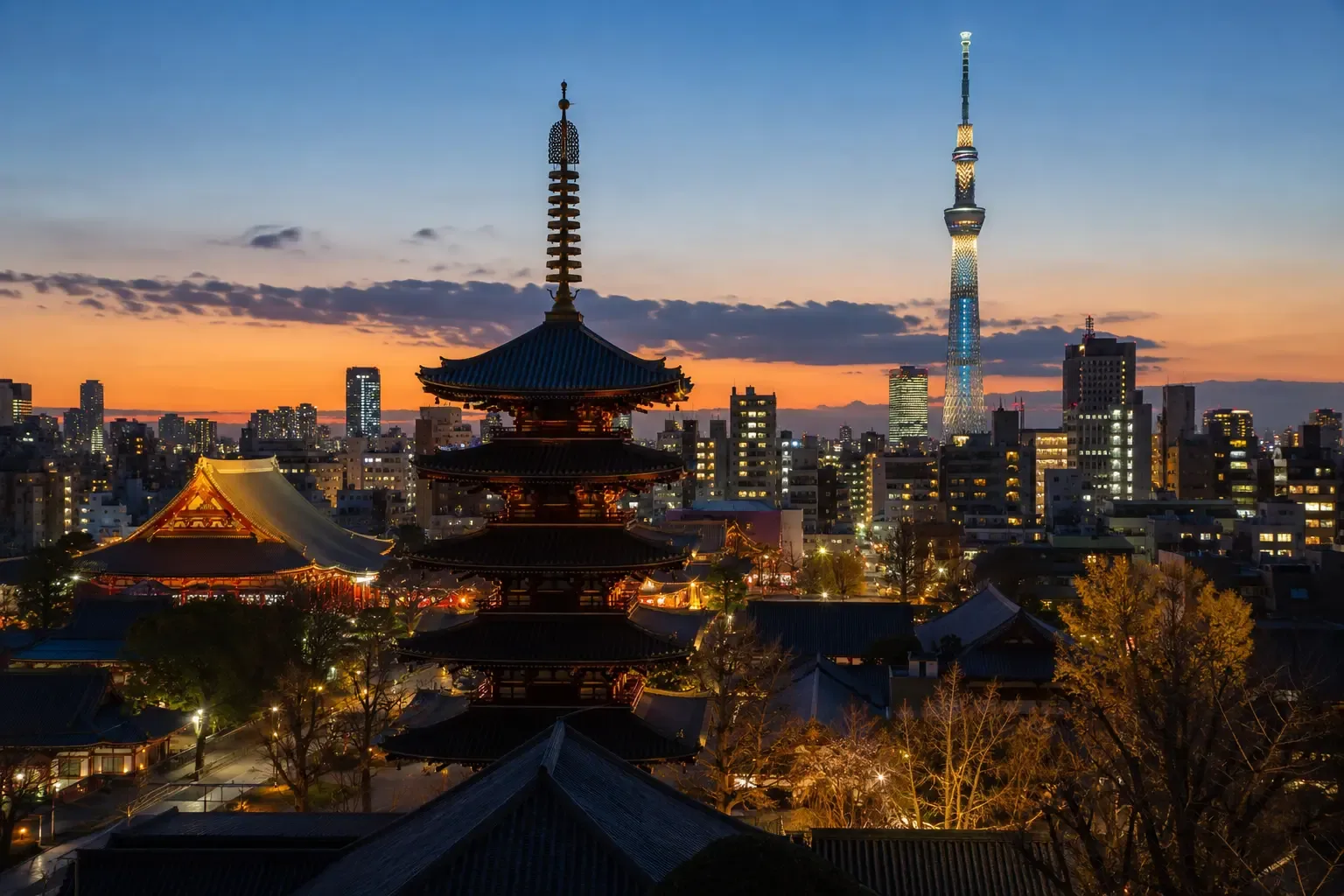
Tokyo is Japan's capital and its biggest, busiest, most varied city — home to ancient temples, neon-lit shopping streets, world-class food, and some of the best public transport on earth. Most first-time visitors spend 3–5 days here, staying near Shibuya, Shinjuku, or Asakusa, and get around almost entirely by train using a Suica or Pasmo IC card. The best months to visit are late March to early May and October to November, for mild weather and cherry blossoms or autumn leaves.
Key Takeaways
- Tokyo is huge — think of it as a collection of very different neighborhoods, not one single "downtown." Pick 3–4 areas to focus on rather than trying to see everything.
- Trains are the easiest way to get around. Load a Suica or Pasmo IC card onto your phone, or buy a physical Welcome Suica card at the airport, and you can tap onto almost every train, subway, and bus in the city.
- Plan at least 3 full days for a first visit — 4–5 days lets you slow down and add a day trip.
- Spring (late March–early May) and autumn (October–November) have the best weather, but they're also the busiest and most expensive times to visit.
- Book popular hotels and any teamLab, sumo, or Studio Ghibli Museum tickets well in advance — these sell out fastest.
Introduction
Tokyo is not one city — it's dozens of them stitched together. One train stop can take you from a quiet backstreet shrine to a crossing with more foot traffic than almost anywhere else on the planet. That's what makes it exciting, and also what makes it a little overwhelming to plan for the first time.
This guide covers everything you need to build a real Tokyo trip: how to get here and get around, which neighborhoods are worth your time, what to eat, where to sleep, and when to go. By the end, you should be able to start booking flights and hotels with confidence.
1. Why Visit Tokyo
Tokyo mixes centuries-old temples and shrines with some of the most futuristic city blocks in the world, often within a few minutes' walk of each other. You can watch the sun rise over Senso-ji Temple in Asakusa, spend the afternoon in Akihabara's arcades and anime shops, and end the night looking out over the city from an observation deck like Shibuya Sky or Tokyo Skytree.
Food is a huge part of the draw. Tokyo has more Michelin-starred restaurants than any other city in the world, but some of the best meals here cost under 1,500 yen — a bowl of ramen, a plate of conveyor-belt sushi, or a stand-up soba shop near the station. Shopping ranges from Ginza's flagship luxury stores to Shimokitazawa's secondhand clothing racks to the electronics towers of Akihabara.
It's also, for a city its size, remarkably easy to navigate once you understand the train system, and remarkably safe to walk around, even late at night.
2. How to Get to Tokyo
Tokyo is served by two main international airports, and which one you land at affects your first hour or two in the city.
- Haneda Airport (HND) sits much closer to central Tokyo, roughly 30–40 minutes by train or monorail to areas like Shinagawa or Shibuya. Many international flights, including a growing number of long-haul routes, now use Haneda.
- Narita Airport (NRT) is farther out, typically 60–90 minutes to central Tokyo by train, but it still handles a large share of international flights, especially budget carriers.
From either airport, the easiest way into the city is by train. The Narita Express (N'EX) and Keisei Skyliner run from Narita into central Tokyo, while the Tokyo Monorail and Keikyu Line connect Haneda to the city. Airport limousine buses are a good option if you have a lot of luggage or your hotel isn't near a train station, though they take longer in traffic.
If you're arriving by train from elsewhere in Japan, you'll most likely come into Tokyo Station, the city's main Shinkansen (bullet train) hub, or Shinjuku Station, one of the busiest stations in the world and a major hub for local and regional lines.
3. How to Get Around Tokyo
This is the part that intimidates first-time visitors most, and it's also the part that turns out to be simplest once you're actually here.
Get an IC card. A Suica or Pasmo card is the single most useful thing you'll carry in Tokyo. Tap it at the ticket gate to ride any train, subway, or bus, and use it to pay at convenience stores, vending machines, and many restaurants. If your phone supports it, you can add Suica or Pasmo directly to Apple Wallet or Google Wallet before you even land — no physical card needed. If you'd rather have a physical card, a Welcome Suica or Pasmo Passport (designed for short-term visitors, valid for 28 days, no deposit required) can be picked up at counters or vending machines at Narita and Haneda airports and at a handful of major stations in the city.
Understand the train map. Tokyo's rail network is really two overlapping systems: JR East lines (including the loop-shaped Yamanote Line, which touches most major neighborhoods) and the Tokyo Metro / Toei Subway network. Google Maps and the Japan Transit Planner app both handle route planning well and will tell you which line to use and which exit to take.
Consider a day pass if you're moving a lot. If you plan to hop between many subway stations in a single day, a 24, 48, or 72-hour Tokyo Subway Ticket can work out cheaper than paying per ride — but for most itineraries that mix walking with a few train rides a day, a simple pay-as-you-go IC card is easier and often cheaper overall.
Skip the JR Pass if you're only staying in Tokyo. The national Japan Rail Pass is built for travelers hopping between cities by Shinkansen (say, Tokyo–Kyoto–Osaka). If your trip is Tokyo-only, it's not worth the cost — stick with your IC card. If you are combining Tokyo with other cities, run the math on your planned routes before buying, since the pass price has risen in recent years and doesn't always pay for itself anymore.
Walk more than you'd expect. Tokyo neighborhoods reward walking, and stations are often bigger and more spread out than they look on a map — budget extra time to find your exit, especially at mega-stations like Shinjuku and Tokyo Station.
4. Best Neighborhoods to Know
Tokyo doesn't really have a single "center" — instead, get to know these key areas:
| Neighborhood | Known For | Good For |
|---|---|---|
| Shibuya | The famous scramble crossing, youth fashion, nightlife, Shibuya Sky observation deck | First-timers, nightlife, photography |
| Shinjuku | Skyscrapers, Golden Gai bar alleys, Kabukicho, Shinjuku Gyoen park | Nightlife, big-city energy, easy transport hub |
| Asakusa | Senso-ji Temple, traditional streets, rickshaw rides | Traditional culture, first-time visitors |
| Harajuku & Omotesando | Youth fashion on Takeshita Street, upscale boutiques, Meiji Shrine nearby | Fashion, people-watching, shrine visits |
| Akihabara | Anime, manga, electronics, retro game shops, maid cafés | Anime/gaming fans, tech lovers |
| Ginza | Flagship luxury stores, high-end dining, art galleries | Shopping, fine dining, a polished evening out |
| Roppongi | Nightlife, art museums (Mori Art Museum, 21_21 Design Sight) | Nightlife, art, expat-friendly bars |
| Ueno | Ueno Park, museums, Ameyoko market street, zoo | Museums, budget shopping, families |
Most first-time visitors do best basing themselves near Shibuya, Shinjuku, or Asakusa — all are well connected to the rest of the city by train.
5. Top Things to Do in Tokyo
Senso-ji Temple, Asakusa. Tokyo's oldest and most famous temple, approached through the lantern-lined Nakamise shopping street. Go early in the morning, before 8 am if you can, to see it without the crowds.
Meiji Shrine, Shibuya/Harajuku. A forested Shinto shrine dedicated to Emperor Meiji, right next to the chaos of Harajuku's Takeshita Street — the contrast between the two is part of what makes them worth visiting back to back.
Shibuya Scramble Crossing and Shibuya Sky. The crossing is famous for good reason — hundreds of people crossing from every direction at once. For the view down onto it (and across the whole city), head up to the Shibuya Sky observation deck.
Tokyo Skytree. One of the tallest structures in the world, with two observation decks looking out over the Sumida River and, on clear days, toward Mount Fuji.
teamLab digital art. Tokyo is home to large-scale, immersive digital art installations that have become a genuine must-see for many visitors — expect rooms of shifting light, projected flowers, and mirrored spaces. These sell out days or weeks ahead, so book online before your trip rather than hoping to walk in.
Akihabara. Multi-floor electronics stores, retro and modern video game shops, anime merchandise, and arcades. Even if gaming and anime aren't your thing, it's worth a walk through for the atmosphere alone.
Tsukiji Outer Market and Toyosu Market. The old Tsukiji fish market's outer market area is still full of food stalls and small restaurants for an early breakfast of fresh seafood. The main wholesale fish auctions moved to Toyosu Market, which also has public viewing areas if you want to see the action itself.
Ginza. Come for window-shopping at flagship stores, but also just for the architecture and the feeling of Tokyo's most polished district. Weekend afternoons often close the main street to cars, turning it into a pedestrian zone.
Golden Gai and Omoide Yokocho, Shinjuku. Two tiny, atmospheric alleyways packed with closet-sized bars and yakitori stalls — a completely different side of Shinjuku from its skyscrapers.
Ueno Park and its museums. A large public park with several major museums (including the Tokyo National Museum) and, in spring, some of the city's most popular cherry blossom viewing spots.
6. What to Eat in Tokyo
Tokyo's food scene works at every budget. A few things worth seeking out specifically:
- Sushi — from a stand-up sushi counter near the station to a full omakase (chef's choice) tasting menu. Tsukiji's outer market is a classic spot for a fresh, casual sushi breakfast.
- Ramen — every neighborhood has its own favorite shop; styles vary from rich tonkotsu (pork bone) broth to lighter shoyu (soy sauce) based bowls.
- Yakitori — grilled skewers of chicken and vegetables, best eaten at a small counter bar in an alley like Omoide Yokocho, ideally with a cold beer.
- Konbini food — don't underestimate a Japanese convenience store (7-Eleven, Lawson, FamilyMart). The onigiri (rice balls), sandwiches, and hot food are genuinely good and extremely cheap.
- Depachika food halls — the basement floors of major department stores are full of beautifully presented takeaway food, from bento boxes to pastries, and are a great way to sample a lot of different things at once.
- Tempura, tonkatsu, and soba — all classic, satisfying options if you want something more substantial than street food but less formal than a tasting menu.
7. Where to Stay in Tokyo
Where you base yourself matters more in Tokyo than in a lot of cities, simply because of its size.
- Shibuya — best for first-timers who want to be in the middle of the action, with excellent train connections and easy access to nightlife.
- Shinjuku — a strong all-round choice, especially if you're arriving by train, thanks to its huge station and direct airport connections.
- Asakusa — a quieter, more traditional base, good for families and travelers who want a slower pace with easy access to Senso-ji and the Sumida River.
- Ginza — a polished, central option for travelers who want upscale hotels and easy access to shopping and fine dining.
- Akasaka — a calmer, park-filled neighborhood popular with families, close to Roppongi and central government districts but noticeably less hectic.
Tokyo hotel rooms tend to be smaller than what North American or European travelers may be used to — this is normal, not a downgrade, and reflects how the whole city uses space efficiently. Capsule hotels and business hotels are worth considering for solo travelers or anyone prioritizing budget and location over room size.
8. Best Time to Visit Tokyo
Tokyo has four distinct seasons, and the best time for you depends on what you want out of the trip.
| Season | Months | Weather | Highlights | Crowds & Prices |
|---|---|---|---|---|
| Spring | Late March–May | Mild, warming through the season | Cherry blossoms (typically late March–early April) | High, especially late March–April and Golden Week (late April–early May) |
| Summer | June–August | Hot, humid, rainy in June–July | Festivals, fireworks | Moderate, but heat can be intense |
| Autumn | September–November | Mild, drier | Autumn leaves, especially in November | High in November |
| Winter | December–February | Cold, dry, clear skies | Winter illuminations, fewer crowds, clear Mount Fuji views | Lower, except around New Year |
If you want good weather and don't mind crowds and higher prices, aim for late March to early May or October to November. If you'd rather have short lines and lower hotel rates and don't mind cooler weather, winter (excluding the New Year period) is a genuinely underrated time to visit — you get clear skies and a much calmer city.
9. How Much Does Tokyo Cost
Costs vary enormously depending on your travel style. As a rough daily guide per person, not including flights or accommodation:
| Style | Daily Food & Activities (est.) | Typical Accommodation |
|---|---|---|
| Budget | ¥3,000–5,000 | Hostel dorm or capsule hotel |
| Mid-range | ¥6,000–10,000 | 3-star hotel or business hotel |
| Comfortable | ¥12,000+ | 4–5 star hotel |
Transport is one of the cheapest parts of a Tokyo trip if you stick to trains and buses rather than taxis — a typical single subway ride runs a few hundred yen. Prices for attractions, transport, and hotels change often, so treat these figures as a starting point and check current pricing before you book.
10. Sample 4-Day Tokyo Itinerary
Day 1 — Traditional Tokyo: Morning at Senso-ji Temple and Nakamise shopping street in Asakusa, then a boat or short train ride toward Ueno Park and its museums in the afternoon.
Day 2 — Shibuya & Harajuku: Meiji Shrine in the morning, then Takeshita Street and Omotesando in Harajuku, finishing at Shibuya Scramble Crossing and Shibuya Sky at sunset.
Day 3 — Modern Tokyo: Akihabara in the morning for anime, games, and electronics, teamLab digital art in the afternoon (book ahead), then dinner and drinks in Shinjuku's Omoide Yokocho or Golden Gai.
Day 4 — Shopping, food, and views: Tsukiji Outer Market for breakfast, Ginza for shopping in the late morning, and Tokyo Skytree in the afternoon or evening for a final city view.
With a 5th day, consider a day trip (see section 12) to Nikko, Kamakura, or Hakone.
11. Practical Tips & Common Mistakes
- Cash still matters. Tokyo is far more card- and IC-card-friendly than it used to be, but smaller restaurants, temples, and some shops are still cash-only. Keep some yen on hand.
- Don't eat or drink while walking. It's considered a bit rude in most of Japan, including Tokyo — find a spot to stand or sit near where you bought your food instead.
- Trash cans are hard to find. Carry a small bag for your rubbish until you find a bin, often near a convenience store or train station.
- Trains stop running late at night. Most lines stop around midnight to 1 am. Plan your last train home or budget for a taxi if you're out late — taxis in Tokyo are reliable but not cheap.
- Don't try to see everything. Tokyo rewards depth over breadth. Two or three well-explored neighborhoods a day beats a rushed checklist of ten.
- Book popular attractions ahead. teamLab installations, the Studio Ghibli Museum, and top sumo tournament tickets can sell out weeks in advance.
- Learn a few basic phrases. "Sumimasen" (excuse me/sorry), "arigatou gozaimasu" (thank you), and "eigo wa daijoubu desu ka" (is English okay?) go a long way, even though many signs and staff in central Tokyo speak some English.
12. Day Trips from Tokyo
If you have an extra day or two, these are the classic Tokyo day trips:
- Nikko — mountain shrines and elaborate temple complexes, about 2 hours by train.
- Kamakura — a coastal town with the famous Great Buddha statue and quiet hiking trails, under an hour from central Tokyo.
- Hakone — hot springs, mountain scenery, and (on clear days) views of Mount Fuji, roughly 1.5–2 hours away.
- Yokohama — Japan's second-largest city, with a distinct waterfront, Chinatown, and a different pace from Tokyo, about 30–40 minutes away.
Each of these works as a single long day out, or you could combine one with an overnight stay for a slower pace, especially Hakone if you want to try a ryokan (traditional Japanese inn) with an onsen bath.
Frequently Asked Questions
How many days do you need in Tokyo? Plan at least 3 full days to see the highlights — Asakusa, Shibuya, Shinjuku, and one or two more neighborhoods. Four to five days lets you slow down, add a museum or a teamLab visit, and fit in a day trip like Kamakura or Hakone.
Is Tokyo expensive to visit? Tokyo can be as expensive or affordable as you make it. Accommodation and fine dining can be pricey, but everyday costs like convenience store food, ramen shops, and public transport are genuinely cheap by major-city standards. Budget travelers can get by comfortably on a modest daily spend; check current prices before you book, since costs shift over time.
Do I need to speak Japanese to visit Tokyo? No. Central Tokyo is very manageable for English speakers — train signs, station announcements, and many restaurant menus include English, and translation apps cover the rest. Learning a few basic phrases still goes a long way and is appreciated by locals.
What's the best way to get from the airport to central Tokyo? From Haneda, the Tokyo Monorail or Keikyu Line gets you into the city in about 30–40 minutes. From Narita, the Narita Express or Keisei Skyliner takes roughly 60–90 minutes. Both airports also offer limousine buses, which are slower but convenient with a lot of luggage.
Should I buy a Japan Rail Pass for a Tokyo-only trip? Generally no. The Japan Rail Pass is built for travel between cities on the Shinkansen. If you're only staying in Tokyo, a Suica or Pasmo IC card covers everything you need more cheaply. Only consider the JR Pass if you're also visiting other cities like Kyoto or Osaka — run the numbers on your specific route first, since the pass price has increased in recent years.
Is Tokyo safe for solo travelers? Yes, Tokyo is widely considered one of the safest major cities in the world, including for solo travelers and at night. Normal city precautions still apply, but violent crime is rare and public transport is reliable even late in the evening.
What should I avoid doing in Tokyo? Avoid eating while walking down the street, talking loudly on your phone on trains, and blocking train doors while boarding — locals generally step aside to let passengers off first, then board. Also avoid stepping on tatami mats with shoes on, and tipping at restaurants, which isn't part of Japanese dining culture and can cause confusion.
Final Summary
Tokyo rewards a bit of planning but doesn't require overthinking. Get a Suica or Pasmo card sorted before you land, pick a base neighborhood that fits how you want to spend your trip, and choose three or four areas to explore properly rather than rushing through a long checklist. Whether you're drawn to Senso-ji's traditional streets, Shibuya's neon energy, or a quiet evening in an alleyway yakitori bar, Tokyo has more than enough to fill a first visit — and more than enough to justify a second one.