If you’ve ever searched what is digital marketing, you’re not alone. From small businesses to global brands, everyone is talking about digital marketing because that’s where customers spend most of their time—online. Whether it’s Google search, social media, email, or websites, businesses now rely on digital channels to reach, engage, and convert customers.
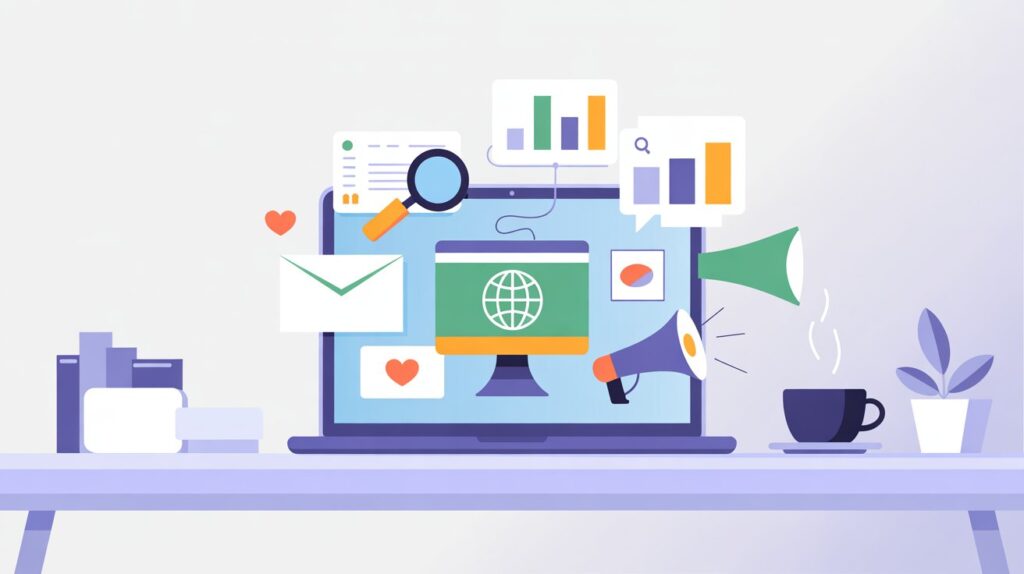
In simple terms, digital marketing refers to promoting products or services using digital platforms such as search engines, websites, social media, and email.
This is why people often search for digital marketing meaning or digital marketing explained—they want a clear, no-confusion understanding of how online marketing actually works in real life.
Unlike traditional marketing methods like newspapers or billboards, digital marketing allows businesses to target the right audience, track results, and adjust strategies in real time. That’s also why online marketing meaning is closely connected to digital marketing today—both focus on reaching users through the internet and digital technology.
In this guide, you’ll learn what digital marketing is, its meaning, how it works, and why it has become essential for modern businesses. No jargon, no hype—just a clear explanation you can actually understand and use.
Quick Answer: What Is Digital Marketing?
Digital marketing is the process of promoting products or services using digital channels such as search engines, websites, social media, email, and online ads. In simple words, digital marketing means reaching customers online where they spend most of their time and converting them into leads or sales.
What Is Digital Marketing? (Detailed Explanation)
To fully understand what is digital marketing, think of it as modern marketing done through digital platforms. Instead of promoting businesses using newspapers, hoardings, or TV ads, digital marketing focuses on reaching people online—where they actively search, scroll, and interact every day.
In practical terms, digital marketing involves using:
- Search engines like Google
- Websites and blogs
- Social media platforms
- Email and online ads
The goal is simple: attract the right audience, engage them, and convert them into customers.
The digital marketing meaning becomes clearer when you break the term into two parts:
- Digital → anything that happens on the internet or electronic devices
- Marketing → promoting products or services to potential customers
So when people ask for digital marketing explained, the most accurate answer is this:
👉 Digital marketing is marketing that happens online using digital technology to grow visibility, traffic, leads, and sales.
This is also why online marketing meaning is often used interchangeably with digital marketing. While online marketing mainly focuses on internet-based channels, digital marketing covers the entire ecosystem of online customer engagement.
In today’s business world, digital marketing is not optional. Whether you run a small local business or a global brand, digital marketing helps you compete, scale, and grow in a measurable way.
Digital Marketing Meaning Explained Simply
When people search for digital marketing meaning, they usually want a simple explanation without technical terms. So here it is, straight up:
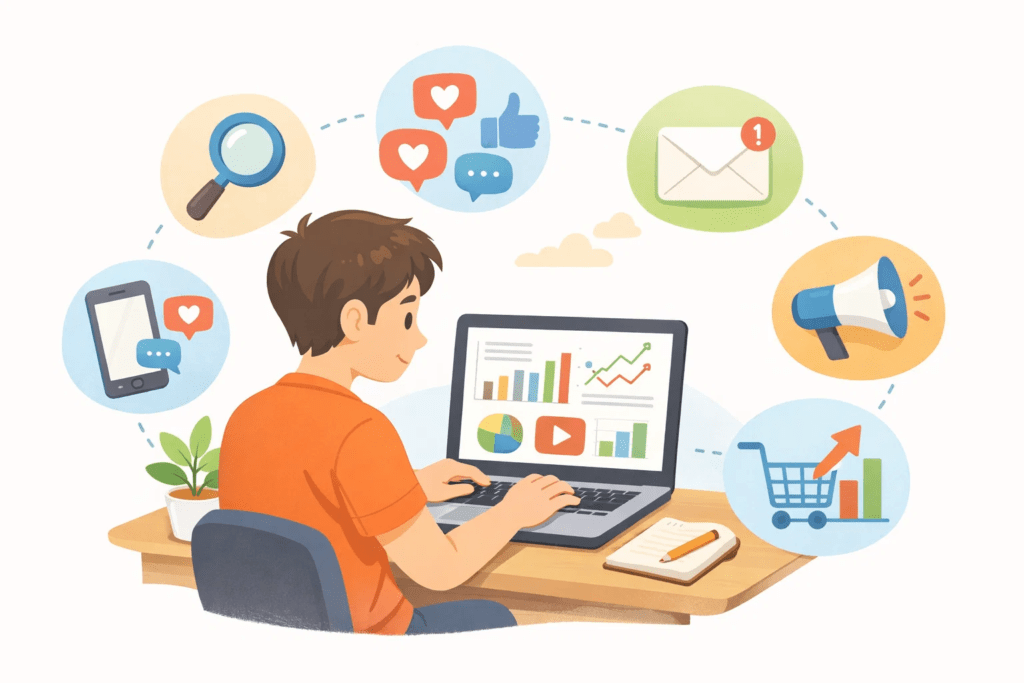
👉 Digital marketing means promoting your business online using digital platforms to reach customers and drive results.
That’s it. No confusion.
To explain it even more clearly, digital marketing is about:
- Showing your business to the right people online
- Communicating your value through digital content
- Turning online visitors into leads or customers
This is why digital marketing explained often focuses on real-world actions rather than theory. For example:
- When someone searches on Google and clicks a website → that’s digital marketing
- When a brand posts on social media to attract customers → that’s digital marketing
- When an email is sent to promote an offer → that’s digital marketing
The digital marketing meaning also connects closely with how people behave today. Most buying decisions now start online—through search engines, social media, reviews, or websites. Digital marketing helps businesses appear exactly at those moments.
Many people also ask about online marketing meaning, and while the terms are closely related, digital marketing is slightly broader. Online marketing focuses mainly on internet-based promotion, while digital marketing includes the full digital customer journey—from discovery to conversion.
In simple words:
👉 Digital marketing is how businesses grow in the digital world by connecting with customers online.
What Is Online Marketing? Is It the Same as Digital Marketing?
When people search for online marketing meaning, they often wonder whether online marketing and digital marketing are the same thing. The short answer is: they are closely related, but not exactly the same.
What Is Online Marketing?
Online marketing refers specifically to promoting products or services through the internet. This includes:
- Search engine marketing (Google search results)
- Social media marketing
- Email marketing
- Website-based promotions
- Online ads
So, the online marketing meaning is simple: marketing activities that happen purely online.
How Is Digital Marketing Different?
Digital marketing is a broader term. It includes online marketing, but it can also cover other digital channels that don’t always require the internet, such as:
- SMS marketing
- Mobile app notifications
- Digital displays
That’s why, when people ask for digital marketing explained, professionals usually say:
👉 Online marketing is a part of digital marketing.
Simple Comparison
- Online marketing → Internet-focused marketing
- Digital marketing → All marketing done using digital technology
In everyday usage, most people use both terms interchangeably, and that’s completely fine. For beginners and businesses, the strategies, tools, and goals often overlap.
In practical terms, whether you call it online marketing or digital marketing, the objective stays the same:
👉 Reach the right audience online and convert them into customers.
How Does Digital Marketing Work?
To understand how digital marketing works, think of it as a step-by-step system that guides people from discovery to conversion. Digital marketing isn’t about random posting or running ads blindly—it follows a clear flow.
Step 1: Attract the Right Audience
The first step in digital marketing is visibility. Businesses use search engines, social media, content, and ads to get in front of people who are already interested in their products or services.
This is a core part of digital marketing explained—showing up at the right place and time.
Step 2: Engage and Build Trust
Once users land on a website, blog, or social page, digital marketing focuses on engagement. This can include:
- Helpful content
- Clear messaging
- Social proof
- Email follow-ups
The goal is to build trust, not push a sale immediately.
Step 3: Convert Visitors into Leads or Customers
After trust is built, digital marketing strategies guide users to take action—such as filling a form, booking a call, or making a purchase.
This is where the digital marketing meaning becomes practical: turning attention into results.
Step 4: Measure and Optimize
One of the biggest advantages of digital marketing is tracking. Businesses can measure:
- Website traffic
- Clicks and conversions
- Cost per lead
- ROI
Based on this data, strategies are improved continuously.
Step 5: Scale What Works
Once a strategy proves successful, businesses scale it by increasing budgets, expanding content, or targeting new audiences.
Types of Digital Marketing
To fully understand what is digital marketing, you need to know the different channels used to promote businesses online. Each type of digital marketing serves a specific purpose, but together they create a complete online growth system.
Below are the most important types of digital marketing explained in simple terms.
1️⃣ Search Engine Optimization (SEO)
SEO is the process of optimizing a website to rank higher on search engines like Google. When people search for products, services, or information, SEO helps your website appear organically in search results.
SEO is one of the most powerful forms of digital marketing because it brings long-term, free traffic.
2️⃣ Pay-Per-Click Advertising (PPC)
PPC involves running paid ads on platforms like Google Ads or social media. Businesses pay only when someone clicks on their ad.
This type of digital marketing is ideal for:
- Fast results
- Targeted campaigns
- Lead generation
3️⃣ Social Media Marketing
Social media marketing focuses on promoting businesses through platforms like Facebook, Instagram, LinkedIn, and Twitter. It helps brands build awareness, engage users, and drive traffic.
This channel plays a major role in digital marketing explained for modern audiences.
4️⃣ Content Marketing
Content marketing involves creating valuable content such as blogs, videos, guides, and infographics to attract and educate users. Instead of selling directly, content marketing builds trust over time.
This is why content is considered the backbone of digital marketing.
5️⃣ Email Marketing
Email marketing is used to communicate directly with interested users through newsletters, offers, and updates. It is one of the most cost-effective digital marketing channels when done correctly.
6️⃣ Affiliate Marketing
Affiliate marketing allows businesses to partner with others who promote their products in exchange for a commission. This model is performance-based and commonly used in eCommerce and blogging.
In simple terms:
👉 Each type of digital marketing helps businesses reach customers at different stages of their online journey.
Why Digital Marketing Is Important for Businesses
Understanding what is digital marketing is only half the picture. The real question businesses ask is: why is digital marketing so important today? The answer lies in how customers behave and how businesses grow in the digital age.
1️⃣ Reach the Right Audience
Digital marketing allows businesses to target specific audiences based on location, interests, behavior, and intent. Unlike traditional marketing, you’re not wasting money on people who aren’t interested.
This targeting ability is a key part of digital marketing explained.
2️⃣ Cost-Effective Compared to Traditional Marketing
Digital marketing is often more affordable than TV, newspaper, or billboard advertising. Even small businesses can compete with larger brands using smart digital strategies.
This makes the digital marketing meaning especially valuable for startups and local businesses.
3️⃣ Measurable Results and Clear Data
One of the biggest advantages of digital marketing is tracking. Businesses can see exactly:
- How many people visited their website
- Where traffic came from
- What actions users took
This level of transparency doesn’t exist in traditional marketing.
4️⃣ Builds Trust and Brand Authority
Consistent online presence through content, reviews, and social media builds credibility. Customers trust brands they see repeatedly and find helpful information from.
This directly connects to how online marketing meaning translates into real-world trust.
4️⃣ Builds Trust and Brand Authority
Consistent online presence through content, reviews, and social media builds credibility. Customers trust brands they see repeatedly and find helpful information from.
This directly connects to how online marketing meaning translates into real-world trust.
In short:
👉 Digital marketing helps businesses grow smarter, faster, and more efficiently in today’s online-driven world.
Digital Marketing Examples (Real-Life Use Cases)
To truly understand what is digital marketing, it helps to see how it works in real life. Below are simple, practical digital marketing examples that show how businesses use online marketing to grow.
Example 1: Local Business Using Digital Marketing
Imagine a local restaurant wants more customers. Instead of printing flyers, they:
- Optimize their Google Business Profile
- Run local SEO
- Post regularly on social media
When nearby users search online, the restaurant appears at the right time. This is digital marketing explained in its simplest form—being visible where customers are already searching.
Example 2: Service-Based Business Generating Leads
A service provider (like a consultant or agency) uses:
- SEO-optimized blog content
- Paid Google Ads
- A landing page with a contact form
Users searching for solutions land on the website, read helpful content, and submit their details. This shows how digital marketing meaning directly connects to lead generation.
Example 3: Online Store Increasing Sales
An eCommerce store uses:
- Social media ads
- Email marketing for offers
- Retargeting ads
Visitors who don’t buy immediately are reminded later through ads or emails. This is a common online marketing meaning example where digital strategies guide users toward purchase decisions.
Example 4: Blogger or Publisher Monetizing Traffic
A blog publishes SEO-focused articles that answer user questions. Traffic comes from search engines, and revenue is generated through ads or affiliate links.
This is digital marketing at work without selling a product directly—content becomes the growth engine.
What These Examples Show
All these examples have one thing in common:
- They target the right audience
- They use digital channels strategically
- They focus on long-term growth
That’s the real power behind digital marketing.
Traditional Marketing vs Digital Marketing
To understand what is digital marketing fully, it helps to compare it with traditional marketing. Both aim to promote products or services, but the methods and results are very different.
Traditional Marketing
Traditional marketing includes offline promotion methods such as:
- Newspapers and magazines
- Television and radio ads
- Billboards and posters
- Flyers and brochures
While traditional marketing can build brand awareness, it has limitations:
- High cost
- Limited audience targeting
- Difficult to track results
- One-way communication
Digital Marketing
Digital marketing uses online platforms to reach customers, including:
- Search engines
- Websites and blogs
- Social media
- Email and online ads
This is where digital marketing explained becomes more powerful. Digital marketing allows:
- Precise audience targeting
- Real-time performance tracking
- Flexible budgets
- Two-way interaction with users
Key Differences at a Glance
| Factor | Traditional Marketing | Digital Marketing |
|---|---|---|
| Cost | Expensive | Cost-effective |
| Reach | Limited | Global |
| Targeting | Broad | Highly specific |
| Tracking | Difficult | Easy and accurate |
| Flexibility | Low | High |
Which One Is Better?
Digital marketing is generally more effective for modern businesses because it offers better control, data, and scalability. However, some brands still combine both for maximum exposure.
In today’s online-first world, digital marketing has become the preferred choice for growth-focused businesses.
Advantages and Disadvantages of Digital Marketing
To clearly understand what is digital marketing, it’s important to look at both sides. While digital marketing offers powerful benefits, it also comes with a few challenges businesses should be aware of.
✅ Advantages of Digital Marketing
1️⃣ Cost-Effective Marketing
Digital marketing is generally more affordable than traditional marketing. Businesses can start with small budgets and still reach a targeted audience. This makes it ideal for startups, small businesses, and solo creators.
This is one of the biggest reasons digital marketing meaning is associated with smart growth.
2️⃣ Highly Targeted Reach
Digital marketing allows businesses to target users based on:
- Location
- Interests
- Search intent
- Online behavior
This level of targeting makes digital marketing explained far more efficient than offline methods.
2️⃣ Highly Targeted Reach
Digital marketing allows businesses to target users based on:
- Location
- Interests
- Search intent
- Online behavior
This level of targeting makes digital marketing explained far more efficient than offline methods.
4️⃣ Faster Results and Scalability
Paid ads and optimized content can start delivering results quickly. Once something works, businesses can scale campaigns without rebuilding everything from scratch.
❌ Disadvantages of Digital Marketing
1️⃣ High Competition
Because digital marketing is accessible, competition is intense. Ranking on search engines or running profitable ads requires consistent effort and strategy.
2️⃣ Requires Skills and Learning
Digital marketing isn’t “set and forget.” It requires learning tools, platforms, and strategies. Without proper knowledge, results may take longer.
3️⃣ Dependency on Technology
Digital marketing depends on internet access, platforms, and algorithms. Changes in algorithms or policies can impact performance.
The Balanced Truth
Despite a few challenges, the advantages of digital marketing far outweigh the disadvantages for most businesses. With the right strategy, digital marketing becomes a long-term growth engine.
Is Digital Marketing a Good Career in 2026?
If you’re learning what is digital marketing, the next natural question is whether it’s worth pursuing as a career. In short—yes, digital marketing is still a strong and growing career choice in 2026, especially for people who want flexibility and scalability.
Why Digital Marketing Is in High Demand
Businesses of all sizes now rely on online channels to acquire customers. This constant demand creates opportunities for:
- Digital marketers
- SEO specialists
- Social media managers
- Content creators
- Paid ads experts
This demand is why digital marketing explained often includes career growth and income potential.
Career Paths in Digital Marketing
Digital marketing isn’t just one job. You can specialize in:
- SEO
- Paid advertising (Google Ads, social ads)
- Social media marketing
- Email marketing
- Content marketing
- Analytics and conversion optimization
Each path offers different roles, income levels, and growth opportunities.
Freelancing, Jobs, and Business Opportunities
One of the biggest advantages of digital marketing as a career is flexibility. You can:
- Work in a company
- Freelance for multiple clients
- Start your own agency
- Build blogs or online brands
This makes the digital marketing meaning more than just a skill—it becomes a business opportunity.
Skills Required to Succeed
To build a career in digital marketing, you need:
- Analytical thinking
- Creativity
- Basic technical knowledge
- Continuous learning mindset
The field evolves constantly, so staying updated is key.
Final Career Verdict
Digital marketing is a future-proof career for those willing to learn and adapt. With growing online competition, skilled digital marketers will remain valuable in 2026 and beyond.
FAQs – Digital Marketing (People Also Ask)
1️⃣ What is digital marketing?
Digital marketing is the practice of promoting products or services using digital channels such as search engines, websites, social media, email, and online ads. It helps businesses reach customers online and drive measurable results.
2️⃣ What is digital marketing meaning in simple words?
In simple words, digital marketing means marketing done online. It focuses on reaching people through the internet and digital platforms where they spend most of their time.
3️⃣ What is online marketing meaning?
Online marketing refers to marketing activities that happen strictly through the internet, such as websites, search engines, email, and social media. Online marketing is a part of digital marketing.
3️⃣ What is online marketing meaning?
Online marketing refers to marketing activities that happen strictly through the internet, such as websites, search engines, email, and social media. Online marketing is a part of digital marketing.
6️⃣ What are the main types of digital marketing?
The main types of digital marketing include SEO, PPC advertising, social media marketing, content marketing, email marketing, and affiliate marketing.
7️⃣ Is digital marketing easy for beginners?
Digital marketing is beginner-friendly, but it requires learning and practice. While basic concepts are easy to understand, mastering digital marketing takes time and real-world experience.
8️⃣ How long does digital marketing take to show results?
Results depend on the strategy. Paid ads can show results quickly, while SEO and content marketing usually take weeks or months to deliver long-term growth.
9️⃣ Is digital marketing expensive?
Digital marketing can be affordable or expensive depending on the approach. Many strategies, like SEO and content marketing, can be started with low budgets and scaled over time.
🔟 Is digital marketing a good career choice?
Yes, digital marketing is a strong career option with opportunities in jobs, freelancing, and business ownership. Demand for skilled digital marketers continues to grow worldwide.
Key Takeaways: What Is Digital Marketing?
- Digital marketing is the practice of promoting products or services using online and digital platforms.
- The core digital marketing meaning is reaching customers where they spend most of their time—online.
- Online marketing is a part of digital marketing, but digital marketing covers the full digital customer journey.
- Digital marketing works by attracting, engaging, converting, and scaling online audiences.
- Common types include SEO, PPC, social media marketing, content marketing, email marketing, and affiliate marketing.
- Digital marketing is cost-effective, measurable, and scalable compared to traditional marketing.
- Real-life examples show how businesses use digital marketing to generate traffic, leads, and sales.
- Digital marketing is a strong career option in 2025 with job, freelancing, and business opportunities.
Conclusion
Now that you understand what is digital marketing, it’s clear why it has become a core growth strategy for modern businesses. Digital marketing isn’t just about running ads or posting on social media—it’s about building visibility, trust, and long-term relationships with customers through digital channels.
The true digital marketing meaning lies in its ability to connect businesses with the right audience at the right time. Whether through search engines, content, social media, or email, digital marketing allows brands to grow in a targeted, measurable, and scalable way. This is why digital marketing explained today always focuses on strategy, data, and user intent rather than guesswork.
For beginners, digital marketing offers a low barrier to entry and high growth potential. For businesses, it provides a powerful way to compete, even against larger brands. And for professionals, digital marketing continues to be a future-proof skill with opportunities across industries.
In simple words, digital marketing is no longer optional—it’s how businesses survive and grow in the digital-first world.