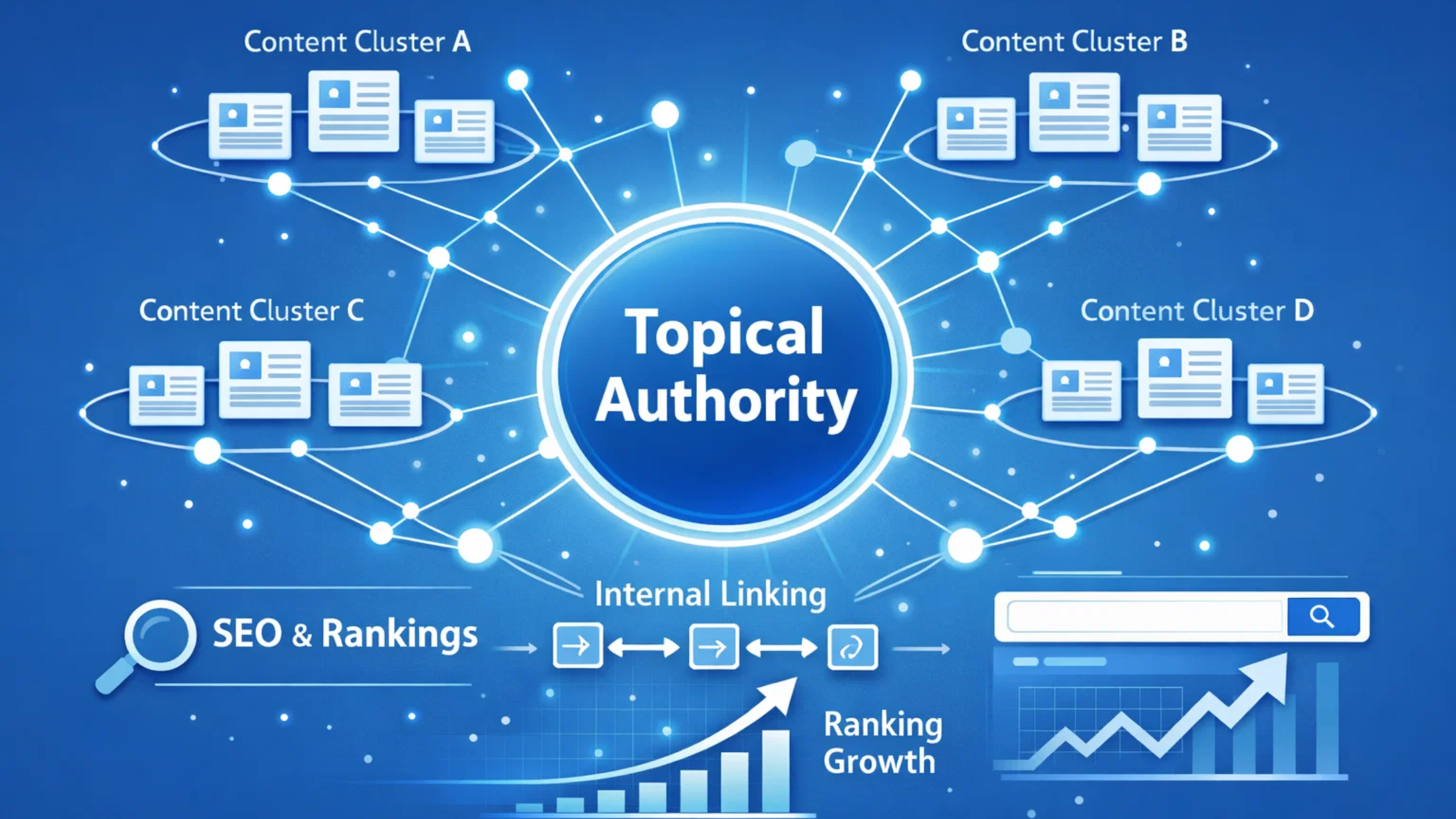
Quick Answer: What Is Topical Authority?
Topical authority in SEO refers to the level of expertise and trust a website builds around a specific subject by publishing comprehensive, high-quality content that covers the topic from multiple angles. When a site consistently creates content around a related group of keywords and connects those pages through topic clusters and internal links, search engines begin to recognize it as an authoritative source on that topic.
For example, if a website publishes dozens of articles about SEO strategies, keyword research, internal linking, and content marketing, Google starts associating that site with the broader topic of SEO. This recognition can lead to higher rankings in search engine results pages (SERPs), increased organic traffic, and stronger credibility with users.
In simple terms: topical authority means becoming the go-to resource for a specific topic by covering it deeply and consistently.
What Is Topical Authority in SEO?
Topical authority in SEO means a website becomes a trusted expert on a specific topic by publishing comprehensive content that covers that subject from multiple angles. Instead of writing one isolated article, the website creates a network of related pages that answer every important question users might search about that topic.
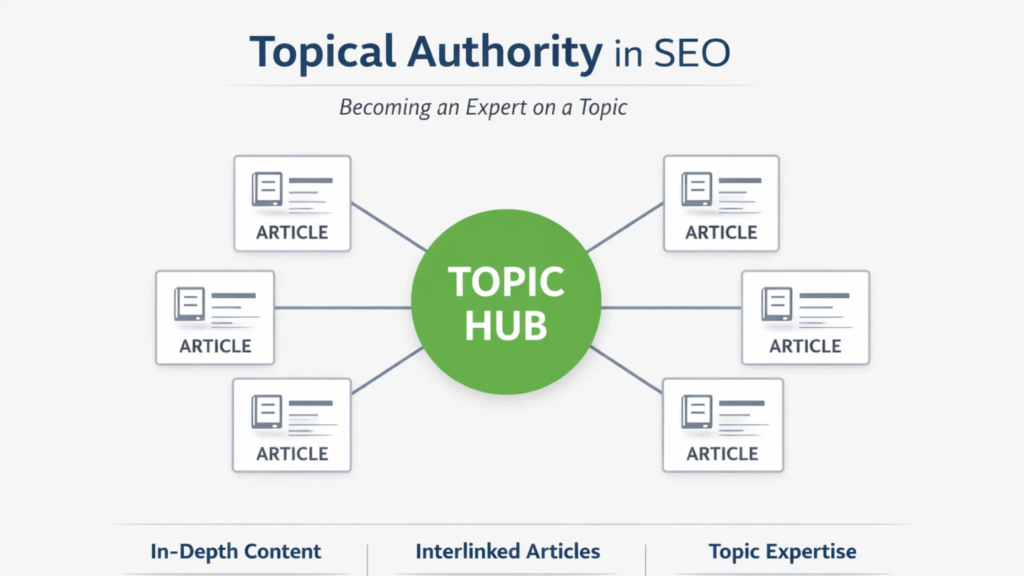
Search engines like Google analyze how deeply a website covers a subject. If your content consistently addresses related queries, uses relevant keywords, and connects articles through internal links and topic clusters, Google starts associating your site with that topic. Over time, this signals that your website has strong topical relevance and expertise, which can help your pages rank higher in search results.
Think of it like this:
- A site with one article about SEO has limited authority.
- A site with 50 interconnected articles covering keyword research, technical SEO, on-page optimization, and link building demonstrates real expertise.
Because of this depth, search engines are more likely to trust the second website when ranking results for SEO-related queries.
Simple Example
Imagine two websites publishing content about digital marketing:
Website A
- One blog post about digital marketing.
Website B
- What is digital marketing
- SEO strategies
- Keyword research guide
- Content marketing strategy
- Link building techniques
- Technical SEO checklist
Website B clearly covers the topic more thoroughly. As a result, search engines see it as more authoritative and relevant, increasing its chances of ranking for many related keywords.
Why Google Values Topical Authority
Modern search algorithms focus heavily on semantic relevance and user intent. Instead of ranking pages purely based on keywords, Google evaluates how well a website answers the broader topic behind a query. When your content consistently provides useful, in-depth information, your site becomes a stronger candidate for higher rankings.
In short, topical authority is built when your website becomes the go-to resource for a subject, offering valuable insights, answering user questions, and connecting related content in a structured way.
Why Topical Authority Matters for SEO
Topical authority has become one of the most powerful concepts in modern SEO. Google no longer ranks pages based only on keywords or backlinks. Instead, the search engine tries to understand which websites truly understand a topic and can provide the most helpful answers to users.
When your website builds strong topical authority, it signals to Google that your content is reliable, comprehensive, and trustworthy, which increases the chances of ranking higher in search results.
1. Higher Rankings in Search Results
Websites with strong topical authority often rank faster and higher for related keywords. When Google recognizes your site as an expert on a subject, it becomes easier for your new pages to rank because the algorithm already trusts your domain in that topic area.
For example, a website with dozens of articles about SEO, keyword research, and technical SEO will have a much better chance of ranking for new SEO-related keywords compared to a site that only has one or two articles on the subject.
2. More Organic Traffic
Topical authority allows your website to rank for hundreds or even thousands of related keywords instead of just a single search term. Because your content covers the full scope of a topic, Google can show your pages for many long-tail searches that users type into search engines.
This means a single well-built content cluster can generate consistent organic traffic over time.
3. Better Trust From Search Engines and Users
Search engines aim to deliver the most reliable and accurate information. When your website consistently publishes detailed content on a topic, it builds credibility not only with Google but also with readers.
As a result:
- Users are more likely to trust your content
- Other websites may reference and link to your pages
- Your brand becomes associated with expertise in that niche
4. Natural Backlink Growth
Authoritative content often attracts backlinks naturally. When your website becomes a trusted resource for a topic, other bloggers, journalists, and websites are more likely to cite your content as a source, which strengthens your overall SEO performance.
Backlinks combined with topical depth create a powerful authority signal for search engines.
5. Long-Term SEO Stability
Unlike short-term SEO tactics, topical authority builds long-lasting visibility. Once your website establishes itself as a trusted source, it becomes harder for competitors to outrank your content unless they produce even deeper and more valuable resources.
This makes topical authority one of the most sustainable strategies for growing organic traffic.
Key Takeaway
Topical authority matters because it helps search engines understand that your website fully covers a subject and provides real value to users. The deeper and more connected your content is around a topic, the stronger your chances of achieving consistent rankings and long-term organic growth.
Topical Authority vs Domain Authority
Many people confuse topical authority with domain authority, but they are two different concepts in SEO. Understanding the difference helps you build a smarter SEO strategy and avoid focusing on the wrong metrics.
In simple terms:
- Domain authority measures the overall strength of a website based largely on backlinks.
- Topical authority measures how deeply a website covers a specific topic.
Both influence rankings, but they work in different ways.
What Is Domain Authority?
Domain authority (DA) is a metric used by SEO tools to estimate how strong a website is based on its backlink profile. Websites that receive many high-quality backlinks from other trusted sites usually have higher domain authority.
For example:
Large platforms like major ecommerce stores, media sites, and popular blogs often have very high domain authority because thousands of websites link to them.
However, having a high domain authority does not automatically mean the website is an expert on every topic.
What Is Topical Authority?
Topical authority focuses on expertise within a specific subject area. A website builds topical authority by creating a large collection of related content that answers different questions about the same topic.
For example, a website about digital marketing might publish content such as:
- SEO guides
- keyword research tutorials
- content marketing strategies
- technical SEO checklists
- link building techniques
When all these articles are connected through internal links and cover the topic thoroughly, search engines start recognizing the website as an authority on SEO and digital marketing.
Example to Understand the Difference
Imagine two websites competing for the keyword “keyword research guide.”
Website A
- High domain authority
- Few articles about SEO
Website B
- Lower domain authority
- Dozens of detailed SEO articles connected together
Even though Website A has stronger backlinks, Website B may still rank higher because it demonstrates strong topical expertise.
Why Topical Authority Is Becoming More Important
Modern search algorithms analyze context, relevance, and depth of content, not just backlinks. If your website covers a topic more comprehensively than competitors, search engines may consider it the better source of information.
This is why many niche websites with moderate domain authority can still outperform larger websites in search rankings.
Key Difference at a Glance
| Factor | Topical Authority | Domain Authority |
|---|---|---|
| Focus | Expertise in a specific topic | Overall website strength |
| Main Signal | Content depth and topic coverage | Backlinks and link quality |
| SEO Impact | Helps rank for related keywords | Helps improve overall ranking potential |
| Strategy | Topic clusters and internal linking | Link building and brand authority |
Key Takeaway
Domain authority shows how strong a website is overall, while topical authority shows how knowledgeable it is about a specific subject. The most successful SEO strategies combine both — strong backlinks and deep topic coverage.
How Google Determines Topical Authority
Google does not publish an official “topical authority score.” Instead, its algorithms analyze multiple signals to determine whether a website is a reliable and knowledgeable source for a specific topic. These signals help Google understand how well your content covers a subject and whether users can trust your website.
When several of these signals align, search engines begin associating your domain with that topic, which strengthens your ability to rank for related keywords.
1. Depth of Content Coverage
One of the strongest indicators of topical authority is how thoroughly a website covers a topic. Google prefers websites that answer many different questions related to the same subject.
For example, if your site focuses on SEO, your content might include articles such as:
- What is SEO
- Keyword research guide
- On-page SEO checklist
- Technical SEO basics
- Link building strategies
- SEO analytics and reporting
When Google sees multiple pages addressing different aspects of the same topic, it understands that your website has comprehensive coverage, which strengthens topical relevance.
2. Semantic Relevance and Related Keywords
Modern search engines use semantic search and natural language processing to understand the meaning behind content rather than just matching keywords.
Instead of focusing on a single keyword, Google looks for related terms and concepts that naturally appear in well-written content. For example, an article about topical authority may also include terms like:
- content strategy
- topic clusters
- internal linking
- organic traffic
- keyword research
- search engine results pages (SERPs)
These related concepts help search engines confirm that your content genuinely covers the topic rather than simply repeating a keyword.
3. Internal Linking Structure
Internal linking plays a critical role in helping search engines understand the relationship between pages on your website.
When related articles link to each other, they create a clear content structure that shows how different topics connect. This structure helps Google identify which pages are central to a topic and which pages support it.
A strong internal linking structure often includes:
- pillar pages covering broad topics
- cluster pages focusing on subtopics
- contextual links connecting the pages together
This type of structure is commonly referred to as a topic cluster model.
4. Backlinks From Relevant Websites
Backlinks remain an important ranking factor, especially when they come from websites that are relevant to your topic. When authoritative websites reference your content, it signals to search engines that your information is credible.
For example, a blog about digital marketing receiving links from other marketing websites, industry publications, or expert blogs will gain stronger topical authority in that niche.
The key is not just the number of backlinks but their quality and relevance.
5. User Engagement Signals
Google also considers how users interact with your content. If visitors stay on your page, explore related articles, and find the information helpful, these behaviors indicate that your website provides value.
Positive engagement signals may include:
- longer time on page
- lower bounce rates
- higher click-through rates from search results
- multiple page visits during a session
These signals suggest that users trust your content and find it useful.
Key Takeaway
Google determines topical authority by evaluating content depth, semantic relevance, internal linking, backlinks, and user engagement. When your website consistently performs well across these factors, search engines begin recognizing it as an authoritative resource within that topic area.
What Are Topic Clusters?
Topic clusters are a content strategy used in SEO to build topical authority. Instead of publishing random blog posts, websites organize their content around a central topic (pillar page) and several related subtopics (cluster pages) that are connected through internal links.
This structure helps search engines understand the relationship between different pages on your website and recognize that your content covers a subject in depth.
The Topic Cluster Model Explained
A typical topic cluster consists of three main elements:
1. Pillar Page
The pillar page is the main article that covers a broad topic in detail. It provides a complete overview and links to more specific articles about related subtopics.
Example pillar topic:
- What Is Topical Authority in SEO
2. Cluster Pages
Cluster pages focus on smaller subtopics related to the pillar page. Each cluster article explores a specific concept in greater detail.
Examples of cluster pages for topical authority:
- Topical Authority vs Domain Authority
- How to Build Topical Authority
- Topic Clusters in SEO
- Internal Linking Strategy for SEO
- Keyword Clustering Explained
3. Internal Links
All cluster pages link back to the pillar page, and the pillar page links to the cluster articles. This internal linking structure helps search engines understand the hierarchy of your content.
Example of a Topic Cluster Structure
Pillar Page
What Is Topical Authority
↓
Cluster Articles
- Topic Clusters in SEO
- Topical Authority vs Domain Authority
- Internal Linking Strategy
- Semantic SEO Explained
- Keyword Clustering Guide
When Google crawls this structure, it sees that your website covers the topic thoroughly, which strengthens your topical authority.
Why Topic Clusters Improve SEO
Topic clusters provide several SEO benefits:
Better search engine understanding
Search engines can clearly see how your content relates to a topic.
Improved internal linking
Cluster pages distribute authority across your website and help important pages rank.
Higher keyword coverage
Your site can rank for many long-tail keywords related to the main topic.
Stronger topical expertise
Covering multiple subtopics signals that your website is a reliable source of information.
Key Takeaway
Topic clusters help transform your website from a collection of individual blog posts into a structured knowledge hub around a specific topic. By organizing content around pillar pages and related cluster articles, you make it easier for search engines to understand your expertise and reward your website with stronger rankings.
How to Build Topical Authority (Step-by-Step)
Building topical authority is not about publishing random articles. It requires a structured SEO strategy that focuses on covering a topic completely. When your website consistently produces high-quality content around a subject and connects it properly, search engines begin to recognize your site as a trusted resource.
Below is a practical step-by-step process to build topical authority for your website.
1. Choose a Core Topic
The first step is selecting a primary topic that aligns with your niche and audience. Instead of targeting broad subjects immediately, focus on a topic that is closely related to your website’s expertise.
For example, if your website focuses on digital marketing, your core topics might include:
- SEO
- content marketing
- social media marketing
- email marketing
- conversion optimization
Choosing a focused topic allows you to build authority faster because your content will revolve around a clear subject area.
2. Perform Topic-Based Keyword Research
Once you have your core topic, the next step is identifying all related keywords and search queries users are asking.
Instead of targeting one keyword per article, group related keywords into clusters. This helps you build content that covers an entire subject rather than isolated keywords.
You can use SEO tools such as:
- Ahrefs
- SEMrush
- Google Keyword Planner
- Google Search suggestions
Look for keywords with:
- relevant search intent
- good search volume
- manageable competition
These keywords will form the foundation of your content cluster strategy.
3. Create a Pillar Page
A pillar page is the main piece of content that covers a broad topic in depth. It acts as the central hub that links to other related articles.
For example, if your topic is topical authority, the pillar page might be:
- What Is Topical Authority in SEO
This page should provide a comprehensive overview of the topic while linking to supporting articles that explore specific aspects in greater detail.
4. Publish Supporting Cluster Content
After creating the pillar page, develop supporting articles that focus on specific subtopics related to the main subject.
Examples of cluster articles for topical authority include:
- Topical Authority vs Domain Authority
- How Topic Clusters Work in SEO
- Internal Linking Strategy for SEO
- Semantic SEO Explained
- Keyword Clustering Guide
Each of these pages expands on a specific concept while reinforcing the overall topic.
5. Build a Strong Internal Linking Structure
Internal linking connects your pillar page with cluster articles and helps search engines understand the relationship between different pieces of content.
A good internal linking structure typically includes:
- links from cluster pages back to the pillar page
- contextual links between related articles
- clear anchor text describing the linked topic
This structure distributes authority across your website and strengthens your topical relevance.
6. Earn Relevant Backlinks
Backlinks from other websites act as signals of credibility and trust. When authoritative sites link to your content, search engines see it as a sign that your information is valuable.
Some effective ways to earn backlinks include:
- guest posting on relevant blogs
- publishing research or case studies
- creating shareable guides and resources
- collaborating with industry experts
The most valuable backlinks come from websites that are topically related to your niche.
7. Update and Expand Your Content Regularly
Topical authority grows over time. As search trends change and new questions emerge, it is important to update your existing content and expand your topic coverage.
Regularly improving your articles can help:
- maintain accurate information
- improve search rankings
- attract more organic traffic
Consistently updating content signals to search engines that your website remains active and authoritative in its field.
Key Takeaway
Building topical authority requires a strategic content ecosystem built around pillar pages, topic clusters, internal linking, and high-quality content. By consistently covering a topic from multiple perspectives and providing valuable information, your website can become a trusted source that search engines prioritize in rankings.
Example of Topical Authority in Real Websites
To understand how topical authority works in practice, it helps to look at real websites that dominate search results by covering a topic deeply. These sites don’t rank because of just one article. Instead, they build large content ecosystems around specific subjects.
Example 1: SEO Blogs and Digital Marketing Sites
Many well-known SEO blogs rank for thousands of keywords related to search engine optimization, keyword research, and content marketing because they have built strong topical authority in the digital marketing space.
For example, these websites publish content such as:
- What is SEO
- Keyword research guides
- Technical SEO checklists
- Link building strategies
- SEO tools reviews
- Content marketing frameworks
Because they cover the topic from multiple angles, search engines associate these sites with SEO expertise, allowing them to rank for a wide range of related keywords.
Example 2: Ecommerce Websites With Content Hubs
Large ecommerce platforms often build topical authority through content hubs that support their products.
For instance, a website selling home improvement products might publish articles like:
- DIY home renovation tips
- How to install kitchen cabinets
- Bathroom remodeling ideas
- Tools needed for home repair
- Interior design guides
These informational articles attract organic traffic and strengthen the site’s authority in the home improvement niche. As a result, the website can rank both product pages and informational content more easily.
Example 3: Health and Fitness Websites
Health websites often demonstrate strong topical authority by publishing detailed resources covering specific health conditions or fitness topics.
A fitness website might create a cluster like this:
Pillar Topic: Weight Loss Guide
Cluster Articles:
- Best exercises for weight loss
- Healthy diet plans
- How metabolism affects weight loss
- Cardio vs strength training
- Common weight loss mistakes
Because all these articles are interconnected and focused on the same topic, the website becomes a trusted resource for people searching for weight loss information.
What These Examples Show
These examples reveal an important pattern:
Websites that dominate search results typically follow three principles:
- They choose a clear niche or topic.
- They publish large amounts of content around that topic.
- They connect related pages through internal linking.
Over time, this strategy builds strong topical authority, which helps the site rank for a wide variety of related keywords.
Key Takeaway
Topical authority is not achieved through a single article. It is built by creating a structured collection of interconnected content that thoroughly covers a subject. The more valuable and comprehensive your content ecosystem becomes, the stronger your authority will be in the eyes of search engines.
How to Measure Topical Authority
Unlike metrics such as domain authority or page authority, topical authority does not have a single official score. Search engines evaluate it by analyzing how well your website covers a subject and how your content performs across related keywords. However, several SEO tools and data points can help you estimate whether your website is building strong topical authority.
Below are some of the most reliable ways to measure it.
1. Number of Ranking Keywords
One of the clearest signs of topical authority is how many keywords related to a topic your website ranks for. When your content covers a subject deeply, your pages start ranking for many long-tail keywords connected to that topic.
For example, a website focused on SEO might rank for keywords such as:
- SEO basics
- keyword research tools
- on-page SEO checklist
- technical SEO guide
- link building strategies
If your website begins ranking for dozens or even hundreds of related keywords within the same topic, it is a strong indicator that search engines recognize your authority in that niche.
2. Organic Traffic Growth
Another way to measure topical authority is by analyzing organic traffic trends. As your topical coverage expands and more pages rank for related keywords, your website should gradually receive more organic traffic from search engines.
You can track this growth using tools like:
- Google Search Console
- Google Analytics
- SEO platforms such as Ahrefs or SEMrush
If multiple articles about the same topic begin generating consistent traffic, it suggests your site is gaining visibility within that subject area.
3. Internal Content Coverage
A simple method to estimate topical authority is to evaluate how much of your website’s content focuses on a specific topic. The more pages you have addressing different aspects of the same subject, the stronger your topical coverage becomes.
For example, if your website contains:
- 1 article about SEO → low topical coverage
- 30 articles about SEO → strong topical coverage
This depth of content helps search engines associate your domain with that topic.
4. Backlinks From Relevant Websites
Backlinks from websites within your niche can also signal growing authority. When other websites reference your content, it shows that your information is considered valuable and trustworthy.
The most beneficial backlinks come from websites that are topically related to your content rather than unrelated sources.
SEO tools like Ahrefs, SEMrush, and Moz can help you monitor:
- referring domains
- link quality
- anchor text relevance
5. Keyword Visibility Tracking
SEO tools allow you to track how your rankings improve across multiple keywords within a topic cluster. If your rankings steadily increase for related keywords over time, it is a sign that your topical authority is strengthening.
Position tracking tools help you monitor:
- keyword ranking changes
- visibility trends
- new keywords your site begins ranking for
Key Takeaway
Topical authority is measured through a combination of signals such as ranking keywords, organic traffic growth, content depth, backlinks, and keyword visibility. By consistently tracking these metrics, you can evaluate whether your website is becoming a stronger authority in its niche.
Common Topical Authority Mistakes to Avoid
Many websites try to build topical authority but fail because their content strategy lacks focus or structure. Even if you publish many blog posts, mistakes in planning and optimization can prevent your website from becoming a trusted authority in search engines.
Understanding these common mistakes can help you build a stronger and more effective SEO strategy.
1. Publishing Random Blog Topics
One of the biggest mistakes is publishing content that is not connected to a clear topic. When articles cover unrelated subjects, search engines struggle to understand what your website specializes in.
For example, a blog that publishes articles about:
- SEO strategies
- travel tips
- fitness workouts
- cooking recipes
creates a mixed content signal. This makes it difficult for search engines to associate the website with a specific niche.
Instead, focus on consistent topic coverage so your content builds expertise in a defined area.
2. Creating Thin or Low-Quality Content
Publishing short or poorly researched articles can weaken your authority rather than strengthen it. Search engines prioritize high-quality, informative content that provides real value to readers.
Thin content usually includes:
- very short articles with little detail
- content copied or rewritten from other websites
- posts that repeat the same information without adding insights
To build topical authority, each article should provide comprehensive information and practical solutions for users.
3. Ignoring Internal Linking
Internal linking is essential for connecting related articles and helping search engines understand your content structure. Without proper internal links, your pages may appear isolated, which weakens topical relevance.
A strong internal linking strategy should:
- connect cluster articles to the pillar page
- link related posts naturally within the content
- use descriptive anchor text that reflects the topic
This structure helps distribute authority across your website.
4. Keyword Cannibalization
Keyword cannibalization occurs when multiple pages on your website target the same keyword or search intent. Instead of helping rankings, these pages compete against each other in search results.
For example, creating separate articles targeting:
- “SEO keyword research”
- “keyword research for SEO”
may cause both pages to compete for the same search query.
A better approach is to consolidate similar topics into one strong article or clearly differentiate the search intent between pages.
5. Ignoring Search Intent
Search intent refers to the purpose behind a user’s search query. If your content does not match what users are actually looking for, it may struggle to rank even if it contains the correct keywords.
Common search intent types include:
- informational searches (learning about a topic)
- navigational searches (finding a specific website)
- transactional searches (buying a product or service)
Aligning your content with the correct search intent improves both rankings and user engagement.
6. Not Updating Old Content
SEO is constantly evolving, and outdated information can weaken your authority. Websites that regularly update their content with new insights, examples, and data tend to maintain stronger rankings.
Updating older content can help:
- keep information accurate
- improve keyword targeting
- refresh internal links
- increase search visibility
Key Takeaway
Building topical authority requires a focused content strategy, high-quality articles, and strong internal linking. Avoiding common mistakes such as random topic selection, thin content, and keyword cannibalization will help your website establish stronger expertise and perform better in search results.
Topical Authority in the Age of AI Search
Search is evolving rapidly with the rise of AI-powered search engines and generative search experiences. Platforms like AI Overviews, conversational search tools, and answer engines now summarize information directly for users. In this environment, topical authority has become even more important because AI systems prioritize trusted, well-structured, and authoritative sources when generating answers.
Websites that demonstrate deep expertise on a topic are more likely to be referenced or cited in AI-generated responses.
Why Topical Authority Matters for AI Search
AI-driven search engines analyze large amounts of content to generate accurate responses. When selecting sources, they tend to rely on websites that consistently publish reliable and comprehensive information on a specific subject.
If your website has strong topical authority, it becomes more likely to appear in:
- AI-generated summaries
- featured snippets
- knowledge panels
- voice search results
This increases visibility even when users do not click directly on traditional search results.
Structured Content Improves AI Understanding
AI systems interpret content more effectively when it is well organized and clearly structured. Articles that use headings, clear explanations, and logical content flow make it easier for search engines to extract useful information.
Helpful structural elements include:
- clear H1 and H2 headings
- concise answer sections
- step-by-step explanations
- well-organized topic clusters
This structure allows AI systems to identify key insights within your content more easily.
The Role of Expertise and Credibility
Modern search algorithms increasingly emphasize credibility signals. Content that demonstrates experience, expertise, authority, and trustworthiness (often referred to as EEAT) tends to perform better in both traditional and AI-driven search results.
Websites can strengthen these signals by:
- publishing well-researched content
- citing credible sources
- including expert insights
- maintaining accurate and updated information
These factors help search engines determine whether your content should be used as a reliable reference.
Creating Content for Both Users and AI
To succeed in the age of AI search, your content should focus on helping users solve problems clearly and efficiently. Articles that provide straightforward explanations and practical guidance are more likely to be surfaced by AI systems.
Instead of writing purely for keywords, prioritize:
- clear answers to common questions
- detailed explanations of complex topics
- comprehensive topic coverage
When your website consistently delivers valuable information, both users and AI-powered search engines begin recognizing it as an authoritative source.
Key Takeaways
Before you start building topical authority for your website, here are the most important points to remember:
- Topical authority means becoming an expert on a specific subject by publishing comprehensive and interconnected content around that topic.
- Search engines rank websites higher when they demonstrate deep knowledge and consistent coverage of a subject.
- Creating topic clusters with a pillar page and supporting articles helps search engines understand your content structure.
- Internal linking plays a major role in strengthening topical relevance across your website.
- Publishing high-quality content consistently can help your website rank for many related keywords, increasing organic traffic.
- Backlinks from relevant websites further strengthen authority and credibility.
- Topical authority is a long-term SEO strategy that builds sustainable search visibility.
Conclusion
Topical authority has become a fundamental concept in modern SEO. Search engines no longer evaluate web pages in isolation. Instead, they analyze how well a website covers a topic and whether it provides reliable, helpful information for users.
Websites that publish comprehensive, well-structured content across related topics are more likely to gain the trust of both search engines and readers. By organizing your content into topic clusters, using strong internal linking, and consistently producing high-quality articles, you can gradually build authority within your niche.
Although establishing topical authority takes time and effort, the long-term benefits are significant. A website that becomes recognized as a trusted source can rank for a wide range of keywords, attract steady organic traffic, and maintain strong visibility in search results.
For businesses, bloggers, and marketers, focusing on topical authority is one of the most effective ways to build sustainable SEO growth and long-term online presence.
Frequently Asked Questions (FAQs)
1. What is topical authority in SEO?
Topical authority refers to the level of expertise a website demonstrates on a specific subject by publishing detailed and interconnected content about that topic.
2. Why is topical authority important for SEO?
Topical authority helps search engines recognize a website as a trusted source for a topic, which can improve rankings, increase organic traffic, and strengthen credibility.
3. How do websites build topical authority?
Websites build topical authority by creating comprehensive content around a topic, organizing it into topic clusters, linking related pages together, and earning relevant backlinks.
4. What are topic clusters in SEO?
Topic clusters are groups of related articles connected to a central pillar page. This structure helps search engines understand the relationship between different pieces of content.
5. How long does it take to build topical authority?
Building topical authority is a gradual process. Depending on the competition and content strategy, it can take several months or longer to establish strong authority in a niche.
6. What is the difference between topical authority and domain authority?
Topical authority measures expertise in a specific subject area, while domain authority reflects the overall strength of a website based largely on its backlink profile.
7. Does internal linking help build topical authority?
Yes, internal linking connects related articles and helps search engines understand your website’s content structure, which strengthens topical relevance.
8. Can small websites build topical authority?
Yes, smaller websites can build topical authority by focusing on a specific niche and consistently publishing high-quality content related to that topic.
9. Which tools help measure topical authority?
SEO tools such as Google Search Console, Ahrefs, SEMrush, and keyword tracking platforms can help analyze keyword rankings, organic traffic, and topical coverage.
10. Is topical authority a ranking factor?
While there is no single official metric called topical authority, search engines evaluate signals like content depth, relevance, internal linking, and backlinks to determine expertise on a subject.