Why Doesn't My Business Appear When People Ask ChatGPT for Recommendations?
AI search is changing how businesses get discovered. This guide explores why some businesses fail to appear in AI recommendations and what SEO strategies can help your brand become more visible across ChatGPT, Google AI Overviews, Perplexity, and Gemini.
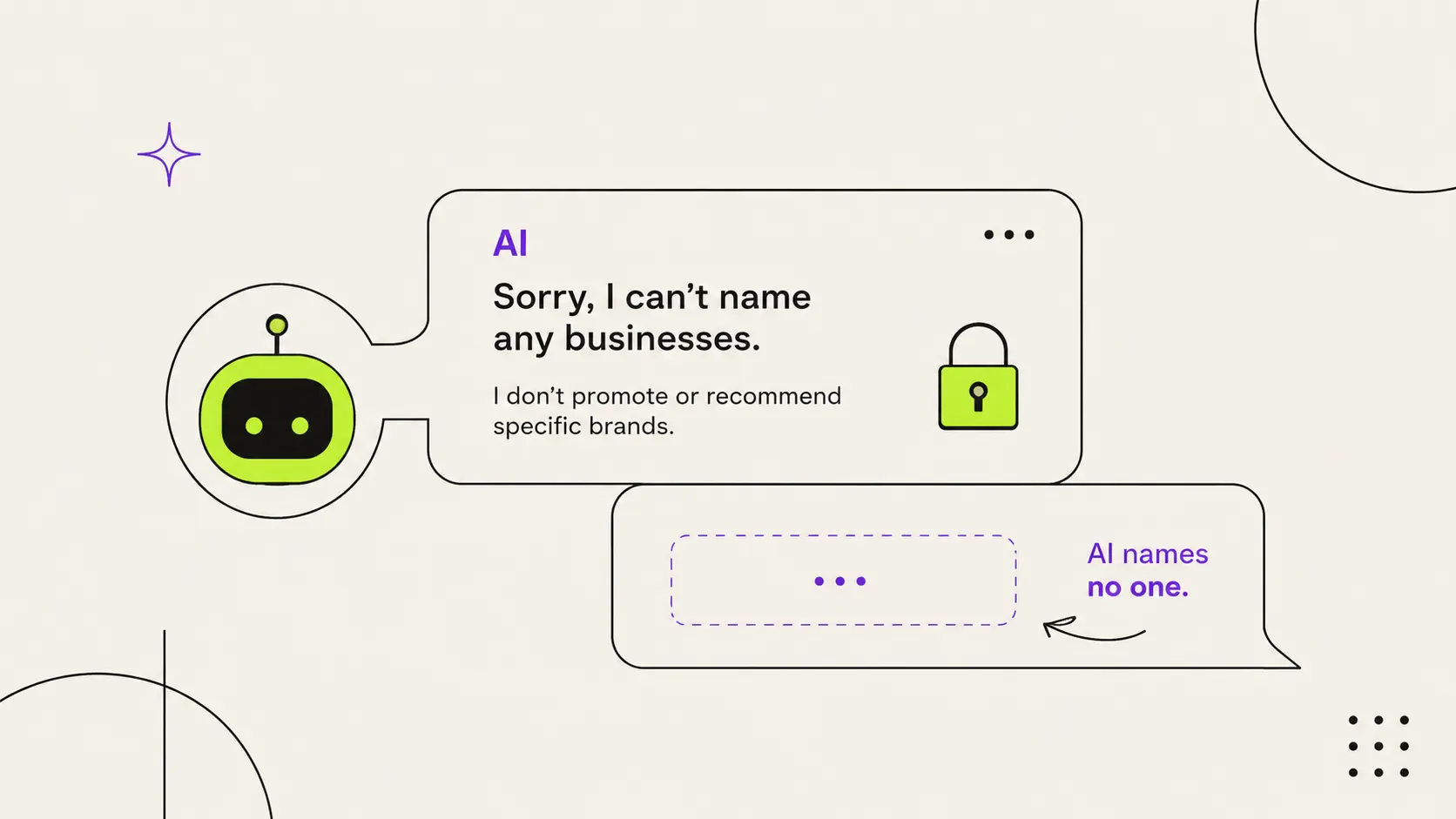
Try it yourself. Open ChatGPT and ask it for the best business in your field, in your city. Watch what happens. Either a competitor gets named instead of you — or, more often than people expect, ChatGPT names nobody in particular and gives a vague, hedged answer.
Both outcomes feel bad. But they mean very different things, and the fix depends on which one you're seeing.
Here's what most articles on this topic get wrong: they treat ChatGPT like Google with a chat box on top. It isn't. ChatGPT doesn't have a ranked list of businesses that you can climb. Once you understand how it actually decides, the reason you're missing becomes obvious — and so does what to do about it.
Quick Answer
Your business doesn't appear in ChatGPT's recommendations for one of three reasons:
- ChatGPT has never clearly learned that you exist — your business isn't well represented in its training data, and you aren't easy to find through live web search either.
- ChatGPT can't confidently understand what you are — your business identity is unclear or inconsistent across the web, so it plays safe and names a clearer competitor.
- Nobody is being recommended at all — for many queries, ChatGPT names no specific business. You're not losing to a rival; the recommendation slot is simply empty.
To fix it, you first need to know which of these is happening. That takes a proper test, not one lucky screenshot.
First, understand how ChatGPT actually decides
ChatGPT answers a "who's the best…" question through two paths.
Path 1 — from memory. It draws on its training data, a large snapshot of the internet up to a certain point. Only businesses that are already well-established in that snapshot exist to it here. A brand-new or thinly-covered business isn't in this memory at all.
Path 2 — live web search. When search is on, ChatGPT browses the web in real time, pulls a set of pages that look relevant, synthesises an answer, and links the sources it used. This is confirmed in OpenAI's own help documentation.
So a real recommendation runs through a simple chain: someone asks → ChatGPT retrieves candidate sources → it synthesises an answer → it cites what it trusted. Your business appears only if a page about you gets retrieved and trusted for that specific question.
Two things follow from this that change everything:
- There is no fixed ranking to climb. The same question can return different businesses on different days, because retrieval is dynamic. No result is permanent or guaranteed.
- Consistency across the whole web matters more than any single page. ChatGPT is measuring how clearly and how often your business is described across independent sources — not one keyword on one page.
The uncomfortable truth: often, nobody is recommended
This is the part almost no one tells you. In one 2026 test panel of 50 buyer-style questions across the major AI engines, most answers named none of the tracked businesses at all. The "best business" slot came back empty far more often than it came back with a competitor.
Large analyses have also found that ChatGPT includes source citations in only about half of its answers. Half the time, it's answering from memory with no live sources at all.
Why this matters for you: if you assumed a competitor is "winning ChatGPT," you may be fighting a battle that isn't happening. The real situation is often that AI doesn't yet trust anyone enough to name them for that query. That's not a loss. That's an open door.
So why is your business missing?
Working through the common causes, most fixable first.
You're too new or too quiet online. If few independent sources describe your business, ChatGPT has little to learn from. This isn't about your website being "bad." It's about your footprint being small.
Your identity is unclear. If ChatGPT can't tell exactly what you do, where you operate, and how you're different, it defaults to a competitor it can describe confidently. Ambiguity loses.
Your information is inconsistent. Your business name, address, phone number, and description are one thing on your site, another on a directory, something else on an old profile. Conflicting details make you look untrustworthy to a machine trying to verify facts.
No independent source backs you up. ChatGPT leans on third-party corroboration — reviews, directories, industry mentions, news. If the only place that says you're good is your own website, that's weak evidence.
Your content isn't extractable. Even when your site is retrieved, if the key facts are buried in images, vague marketing language, or long paragraphs with no clear answer, the model can't cleanly pull them out.
ChatGPT's crawler can't reach you. ChatGPT Search uses its own crawler (OAI-SearchBot). If that's blocked at your server or in robots.txt, you're not eligible to be retrieved live at all.
How to actually test your AI visibility
Don't judge this from one screenshot. AI answers vary run to run, so a single result — good or bad — tells you almost nothing. Here's a simple method that gives you the truth.
- Write 5–10 real buyer questions. The exact things a customer would type: "best [service] in [city]," "affordable [product] for [use case]," "who should I hire for [need]."
- Run each one more than once, and reword it a little each time. AI is sensitive to phrasing.
- Record the details: date, exact wording, whether search was on, your location setting, which businesses were named, and which sources were cited.
- Separate the outcomes. A mention is not a citation is not an active recommendation. Track them apart. Being named as an option is very different from being the answer.
Do this and you'll know whether you're invisible, occasionally mentioned, or genuinely losing to a specific competitor. Each of those needs a different response.
What actually helps (and what nobody can promise)
Let me be honest about the state of this field. Anyone selling you a guaranteed "5 steps and ChatGPT will recommend you" is selling certainty that doesn't exist. What we can say is grounded in how the system works:
- Make your identity unmistakable. A clear "about" and service description — what you do, who for, where — so the model can categorise you without guessing.
- Get the same facts everywhere. Consistent name, location, and description across your site, Google Business Profile, and reputable directories.
- Earn independent mentions. Reviews, genuine directory listings, industry sites, and press. Corroboration is the currency here.
- Make key facts easy to extract. Answer real questions directly on the page, in plain language. Structured data helps machines parse your details — though it never guarantees a citation.
- Let the crawler in. Make sure OAI-SearchBot isn't blocked.
None of these is a hack. They're the same signals that make a business genuinely trustworthy to a human — which is rather the point.
Known vs observed vs hypothesis
Because this area moves fast, it's worth being clear about how sure we are:
- Known: ChatGPT uses training data plus live web retrieval, cites sources when it browses, and has no fixed ranked list. It has no paid placement in organic recommendations as of mid-2026.
- Observed: Consistency, third-party corroboration, and entity clarity line up strongly with which businesses get named. Results vary run to run.
- Hypothesis: The exact weighting of each signal is not published by OpenAI. Anyone stating precise percentages is guessing.
Treat anyone who blurs these three with caution.
Common mistakes
- Judging from one lucky (or unlucky) result. Run the test properly or you're reacting to noise.
- Assuming it works like Google. There's no rank to climb and backlinks aren't counted the way they are in search.
- Chasing ChatGPT while ignoring Google. Most AI engines still lean on the open web you're already building for search. Strong fundamentals feed both.
- Buying "GEO packages" that promise guaranteed AI citations. They can't deliver what they promise.
When this isn't worth chasing yet
If your business is very new, or serves a tiny local area, or almost nobody searches AI for what you sell, pouring effort into AI visibility now may be premature. Your customers might still be finding you through Google Maps, referrals, or plain search. Fix those first.
AI search is worth taking seriously — its share of how people discover businesses is growing. But it's one channel, not the whole game. Don't abandon what's already bringing you customers to chase a slot that, for your niche, may still be mostly empty.
Ritesh's Take
The mindset shift that matters: stop asking "how do I rank number one in ChatGPT?" There is no number one. Start asking "when someone asks about a business like mine, is my information clear, consistent, and backed up by independent sources?"
I've watched businesses panic because a competitor showed up in one AI answer, when a proper test would have shown that competitor appearing maybe once in ten runs — and nobody appearing the other nine times. Measure before you react. The open door I mentioned earlier is real: in most niches, AI hasn't crowned a winner yet. The businesses that get their entity, consistency, and reputation right now are the ones it will trust later.
The same clarity that helps Google understand you — which I covered in why your website isn't showing up on Google — is what helps AI understand you too. This isn't a separate universe. It's the same foundation, read by a different machine.
FAQ
Can I pay to get recommended by ChatGPT? Not in organic recommendations, as of mid-2026. OpenAI has introduced advertising in ChatGPT, but the organic recommendation answer remains separate. The way in is clarity, consistency, and genuine reputation.
Does SEO help me appear in ChatGPT? Indirectly, yes. Live AI search pulls from the open web. Clear, retrievable, well-described pages help both Google and AI engines. But ChatGPT doesn't use Google's rankings directly.
Why does ChatGPT recommend my competitor instead of me? Usually because it can describe them more confidently — clearer identity, more consistent information, more independent sources backing them up. It's rarely that they "beat" you on one factor.
How often do ChatGPT recommendations change? Frequently, because of live retrieval. New content, updated listings, and fresh reviews can shift answers within days or weeks. Training-data knowledge changes more slowly.
Is Google AI different from ChatGPT? Yes. Google AI Overviews lean more on traditional search signals; ChatGPT and Perplexity weight live retrieval and source corroboration differently. The foundations overlap, the details don't.
The one thing to do next
Before you spend a rupee or a dollar on "AI SEO," run the test. Ask ChatGPT your real buyer questions, several times, and write down what it says. You'll almost certainly find one of three things: you're invisible, you're occasionally mentioned, or the slot is empty for everyone. Only then do you know what problem you're actually solving.
Want to know exactly how your business shows up across ChatGPT, Gemini, Perplexity and Google's AI answers — measured properly, not from one screenshot? Get a free AI visibility assessment and I'll show you where you stand and where the realistic gains are. You can also see how I've helped a brand become the cited answer in Google's AI results.