


If you’ve spent even a little time learning SEO, you’ve probably heard people talk about Domain Authority or “DA.”
Many website owners use it to measure how strong or trustworthy a website looks in search engines.
But here’s where most beginners get confused:
Domain Authority is important for SEO analysis, but it is not an official Google ranking factor.
Still, websites with higher authority often perform better in search results because they usually have stronger backlinks, trust, and overall SEO signals.
That’s why understanding Domain Authority can help you analyze competitors, improve your website strategy, and build long-term SEO growth.
What Is Domain Authority?
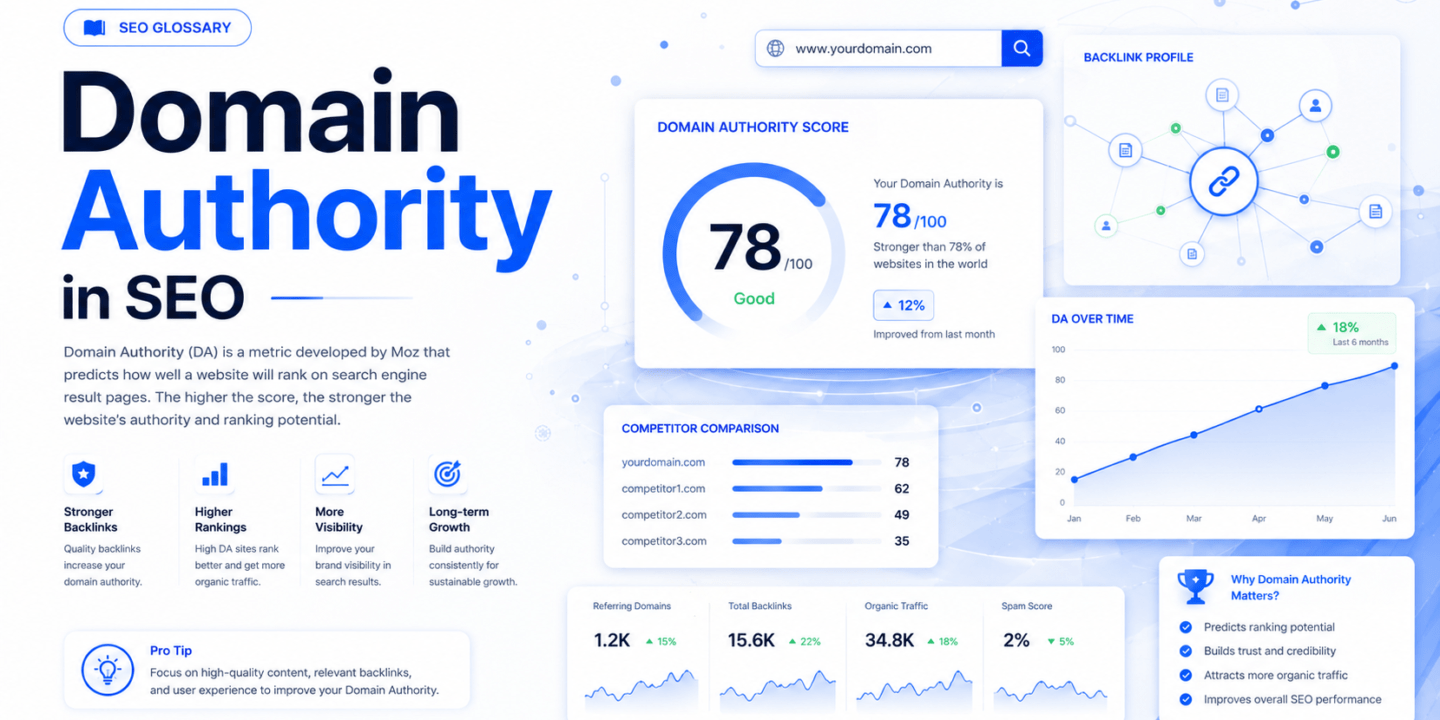
Domain Authority (DA) is a score developed by Moz that predicts how likely a website is to rank in search engine results.
The score ranges from 1 to 100.
Generally:
- Low DA = weaker website authority
- High DA = stronger website authority
For example:
- A brand-new website may have a DA of 1–10
- Medium-sized business websites may range between 30–50
- Big websites like Forbes or Wikipedia often have DA scores above 90
The higher your Domain Authority, the better your chances of competing for competitive keywords.
Understanding Domain Authority with a Simple Example
Imagine two websites writing about the same SEO topic.
Website A:
- Strong backlinks
- Older trusted domain
- High-quality content
- Good technical SEO
Website B:
- New website
- Few backlinks
- Limited authority
Even if both articles are decent, Website A usually has a better chance of ranking because search engines trust it more overall.
That’s the kind of strength Domain Authority tries to measure.
Why Domain Authority Is Important for SEO
Domain Authority helps you understand the overall strength of your website compared to competitors.
While Google does not officially use DA as a ranking factor, the metrics behind it still matter because they reflect real SEO signals like:
- backlink quality
- domain trust
- link popularity
- website credibility
A higher authority website often:
- ranks faster
- indexes quicker
- earns backlinks more easily
- performs better in competitive niches
That’s why many SEO professionals use Domain Authority for competitor analysis and link-building strategies.
How Domain Authority Works
Domain Authority is calculated using multiple factors, but backlinks play the biggest role.
Moz analyzes:
- number of backlinks
- quality of backlinks
- linking root domains
- spam signals
- overall website trust
The score uses a logarithmic scale, which means increasing from:
- 10 to 20 is easier
- 70 to 80 is much harder
So don’t panic if your DA grows slowly over time.
That’s completely normal.
What Is Considered a Good Domain Authority Score?
There’s no universal “perfect” DA score because every niche is different.
However, here’s a general idea:
| Domain Authority Score | SEO Strength |
|---|---|
| 1–10 | Very New Website |
| 10–30 | Growing Website |
| 30–50 | Good Authority |
| 50–70 | Strong Website |
| 70+ | Highly Authoritative |
Instead of chasing a random number, compare your DA with competitors in your industry.
That gives a much more realistic benchmark.
Factors That Improve Domain Authority
Improving Domain Authority takes time because it depends heavily on trust and backlinks.
Some of the biggest factors include:
High-Quality Backlinks
Getting backlinks from trusted websites is one of the strongest authority signals.
A few powerful backlinks are usually better than hundreds of low-quality links.
Strong Content
Publishing valuable, in-depth content naturally attracts backlinks and improves website trust over time.
That’s why topical authority matters so much in modern SEO.
Technical SEO
A technically optimized website helps search engines crawl and understand your content more effectively.
Things like:
- page speed
- mobile optimization
- internal linking
- clean architecture
…all support long-term authority growth.
Consistent SEO Efforts
Domain Authority rarely grows overnight.
Most strong websites build authority gradually through:
- consistent publishing
- SEO optimization
- backlink earning
- brand growth
Common Misunderstandings About Domain Authority
One of the biggest misconceptions is believing DA directly affects Google rankings.
Google has repeatedly stated that it does not use Moz’s Domain Authority metric.
However, websites with high DA usually perform better because they have stronger SEO foundations.
Another mistake is obsessing over DA instead of focusing on real business growth.
Traffic, conversions, rankings, and trust matter far more than chasing vanity metrics.
Domain Authority vs Page Authority
People often confuse Domain Authority with Page Authority.
The difference is simple:
- Domain Authority measures the strength of the entire website
- Page Authority measures the ranking strength of an individual page
For example:
- your homepage may have high authority
- but a brand-new blog post may still have low Page Authority initially
Both metrics help in SEO analysis.
How to Check Domain Authority
You can check Domain Authority using SEO tools such as:
- Moz
- Ahrefs
- SEMrush
- Ubersuggest
These tools provide insights into:
- backlink profiles
- domain strength
- competitor authority
- SEO opportunities
Keep in mind that different tools may use different scoring systems.
Domain Authority in 2026 SEO
In today’s SEO world, authority matters more than ever.
Search engines and AI-driven search platforms increasingly prioritize:
- trusted brands
- authoritative websites
- strong topical expertise
- real backlink credibility
That means websites focusing only on publishing content without building authority may struggle long term.
Modern SEO is no longer just about keywords.
It’s about trust.
And Domain Authority remains one of the easiest ways to estimate that trust level.
Conclusion
Domain Authority is not a direct Google ranking factor, but it is still one of the most useful SEO metrics for understanding website strength.
It helps measure trust, backlink quality, and competitive potential.
A higher DA usually reflects stronger SEO foundations, better link profiles, and greater authority within a niche.
If you want to improve your Domain Authority, focus on:
- high-quality content
- earning trusted backlinks
- technical SEO
- long-term consistency
Because in SEO, authority is built over time — not overnight.
FAQs About Domain Authority
What is Domain Authority in SEO?
Domain Authority is a score developed by Moz that predicts how likely a website is to rank in search engine results.
Is Domain Authority a Google ranking factor?
No, Google does not officially use Domain Authority as a ranking factor.
What is a good Domain Authority score?
A good DA score depends on your industry, but scores above 50 are generally considered strong.
How can I improve my Domain Authority?
You can improve DA by building high-quality backlinks, publishing valuable content, and improving technical SEO.
Does Domain Authority affect rankings?
Indirectly, yes. Websites with higher authority often perform better because they usually have stronger backlinks and trust signals.
How long does it take to increase Domain Authority?
Improving Domain Authority can take months because authority grows gradually over time.
What is the difference between DA and PA?
Domain Authority measures the strength of an entire website, while Page Authority measures the strength of an individual page.
Which tool created Domain Authority?
Moz created the Domain Authority metric.
Can a new website have high Domain Authority?
Most new websites start with low DA because they have fewer backlinks and trust signals.
Why did my Domain Authority drop?
DA can drop because of lost backlinks, algorithm updates, stronger competitors, or changes in your website’s SEO profile.

No Comments