Why Is My Business Visible on Google but Invisible in AI Search?
You rank on Google but AI answers never mention you. Here's why the two systems diverge — and what actually closes the gap between search rankings and AI visibility.
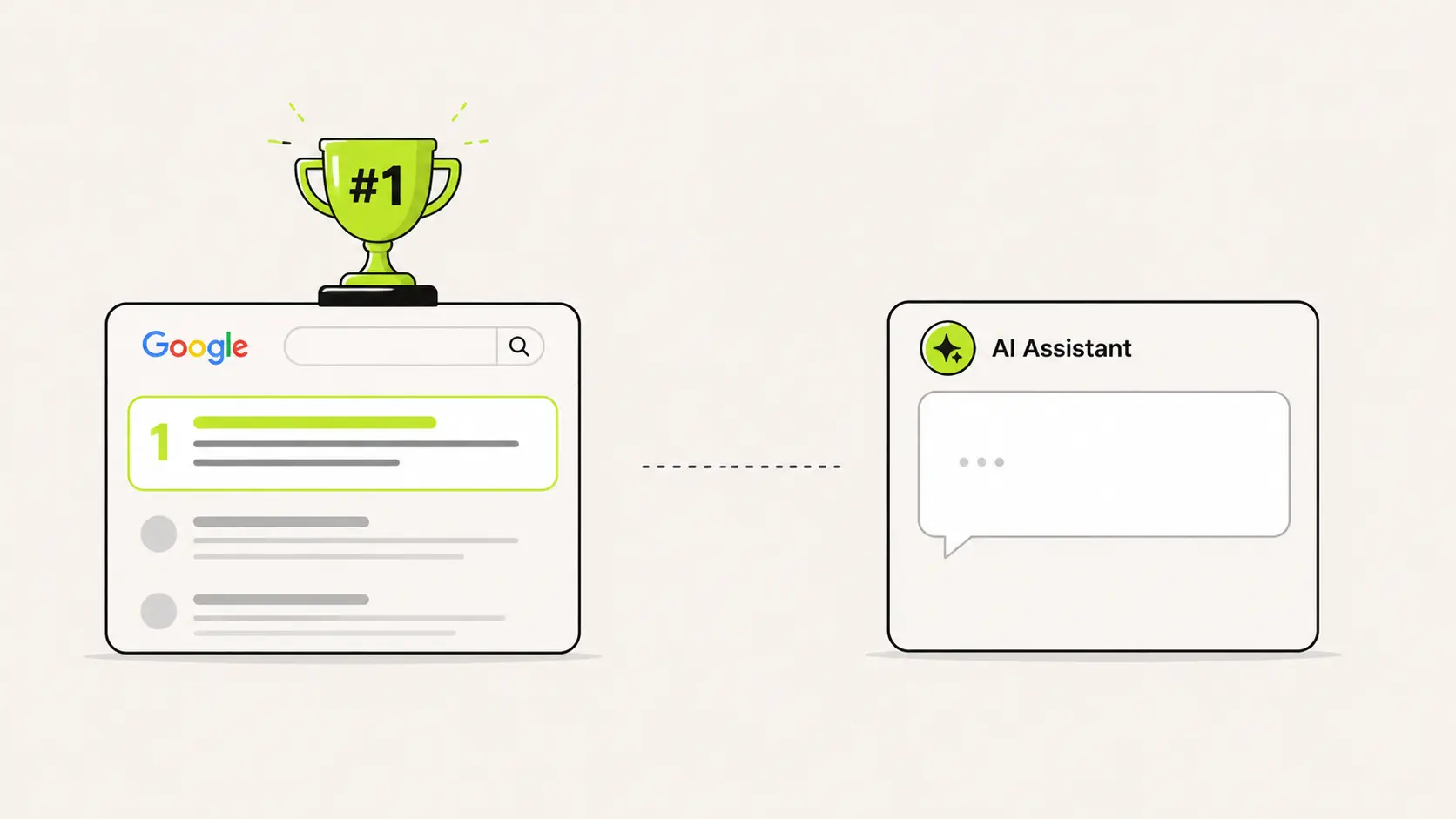
Here's a puzzle that catches a lot of businesses off guard. You rank on page one of Google. You might even be number one for your main keyword. By every traditional measure, your SEO works. Then you ask ChatGPT or read a Google AI Overview for the same topic, and you're nowhere. The AI names other businesses, cites other sources, and acts as if you don't exist.
How can you be visible in one and invisible in the other? Because they're not the same system, and they don't decide things the same way. A top Google ranking and an AI citation are two different prizes, won on two different sets of rules. Once you see why they diverge, closing the gap becomes obvious.
Quick Answer
You can rank on Google but stay invisible in AI search because the two work differently:
- Google ranks individual pages. AI builds an answer from multiple sources it can corroborate.
- Google rewards on-page SEO and links. AI rewards clear identity and agreement across independent sources.
- AI often pulls from third-party sources — reviews, directories, roundups — not just your own site. You can rank and still be missing from those.
- Some AI engines don't use Google's index at all. Different crawlers, different data, different results.
A ranking means one page won a search. An AI citation means the whole web agrees you're a trustworthy answer. Those aren't the same thing.
Google ranks pages. AI builds consensus.
This is the core of it. Google's job is to line up pages and put the most relevant one first. You can win that with a single strong, well-optimised page and some good links.
AI answers work differently. When an AI answers "who's the best [service] in [city]," it isn't ranking your page. It's gathering what multiple sources say, checking whether they agree, and synthesising an answer it feels confident about. It's looking for consensus about you, not a single good page from you.
So a business can have one excellent, top-ranking page — and still lose in AI, because the wider web doesn't clearly and consistently confirm what that page claims. Ranking is a page contest. AI visibility is an agreement contest.
Why the gap opens up
Several specific things cause a strong Google presence to vanish in AI answers.
AI leans on third-party sources. AI answers frequently pull from reviews, directories, industry roundups, and discussion sites — places other people talk about you. If your only strong asset is your own website, you can rank on it while being absent everywhere AI actually looks.
Your entity isn't clear. Google can rank a page for a keyword even if it's a bit fuzzy about who you are as a business. AI is more cautious — if it can't cleanly confirm what you do, who for, and where, it leaves you out and names a business it can describe with confidence.
Your content ranks but doesn't extract. A page can rank while burying its key facts in marketing language, images, or long paragraphs. AI needs to lift a clean, quotable fact. If it can't, it uses a source it can.
Different engines, different data. ChatGPT and Perplexity don't use Google's rankings. They use their own training data and their own crawlers (like OpenAI's OAI-SearchBot). You could dominate Google and still be invisible to an engine that never consulted Google in the first place.
Keywords versus questions. Google visibility is often built around keywords. AI answers respond to full, natural questions. Being number one for "SEO services Delhi" doesn't automatically make you the answer to "who's a trustworthy SEO consultant for a small business in Delhi?"
How to close the gap
The good news: the fixes build on the SEO you've already done rather than replacing it.
- Get talked about off your own site. Earn genuine reviews, real directory listings, and mentions on industry and local sources. AI trusts corroboration, and corroboration lives on other people's pages.
- Make your identity unmistakable. State plainly, everywhere, what you do, who you serve, and where. Remove anything that makes you ambiguous or easy to confuse with another business.
- Keep your facts identical everywhere. Same name, location, and description across your site and every profile. Conflicting details make AI distrust all of them.
- Write answer-shaped content. Answer the real questions buyers ask, directly and in plain language, so an AI can lift a clean fact. Structured data helps machines parse it.
- Let the AI crawlers in. Make sure bots like OAI-SearchBot aren't blocked, so you're eligible to be retrieved by engines beyond Google.
None of this undoes your Google work. It extends it into the places AI reads.
Common mistakes
- Assuming a top ranking guarantees AI visibility. It doesn't. They're separate systems with separate rules.
- Only strengthening your own website. AI reads what others say about you. Ignoring third-party presence leaves the biggest lever untouched.
- Treating all AI engines as one. Google AI, ChatGPT, and Perplexity weight sources differently. What wins one may not win another.
- Chasing AI while your fundamentals are weak. Clear identity and real reputation help both search and AI. Build the foundation once; both benefit.
When the gap doesn't matter yet
Be honest about whether this is worth your energy right now. If your customers still find you mostly through Google search, Maps, and referrals — and few of them use AI to look for businesses like yours — then a missing AI citation isn't costing you much today. Keep the Google visibility that's working and build AI presence steadily in the background.
But the direction of travel is clear. More people are asking AI for recommendations every month. The businesses building corroboration and clarity now are the ones AI will trust as that shift accelerates. It's a "start early" job, not an "emergency" one — for most niches.
Ritesh's Take
The mental model I'd give you: Google asks "which page best answers this search?" AI asks "which business does the whole web agree is a trustworthy answer?" You can win the first with a great page. You only win the second by being clearly and consistently described across the web, not just on your own site.
That reframes the work. Most businesses pour everything into their own website and wonder why AI ignores them. The lever they're missing sits on other people's pages — reviews, directories, mentions, roundups. Your website is the claim. Everything else is the evidence. AI wants the evidence.
If AI is naming a competitor instead of you, that's a related but distinct problem — I break it down in why ChatGPT recommends your competitor instead of you. And you can measure the Google-AI side of your visibility directly in Search Console's new AI performance report.
FAQ
Does ranking number one on Google get me into AI answers? Not automatically. AI builds answers from corroborated sources across the web, not from Google's rankings. A top ranking helps your visibility but doesn't guarantee an AI citation.
Why does AI cite a competitor's directory listing over my website? Because AI trusts independent, third-party sources. A directory or review site talking about your competitor can outweigh your own site talking about yourself.
Do ChatGPT and Google AI use the same information? No. Google AI features draw on Google's systems; ChatGPT and Perplexity use their own training data and crawlers. Their results can differ significantly for the same question.
What's the single biggest thing that closes the gap? Third-party corroboration. Getting genuinely and consistently described across reviews, directories, and industry sources does more for AI visibility than almost anything on your own website.
Will improving AI visibility hurt my Google rankings? No. The work — clear identity, consistent facts, real reputation, extractable content — strengthens both. They reinforce each other.
The one thing to do next
Search a few real buyer questions in ChatGPT and read a couple of Google AI Overviews for your main topics. Note who gets cited and where those citations come from. You'll almost always find they're third-party sources — reviews, directories, roundups. That tells you exactly where to build next: not more of your own website, but more of the web talking about you.
Want to know exactly where your Google visibility is strong but your AI visibility is missing — and what to build first to close the gap? Get an AI visibility audit and I'll map both sides and show you the highest-impact fixes.