Why Does ChatGPT Recommend My Competitor Instead of My Business?
This one stings more than being invisible. You ask ChatGPT for the best business in your field, and it doesn't just skip you — it names your competitor. Confidently…
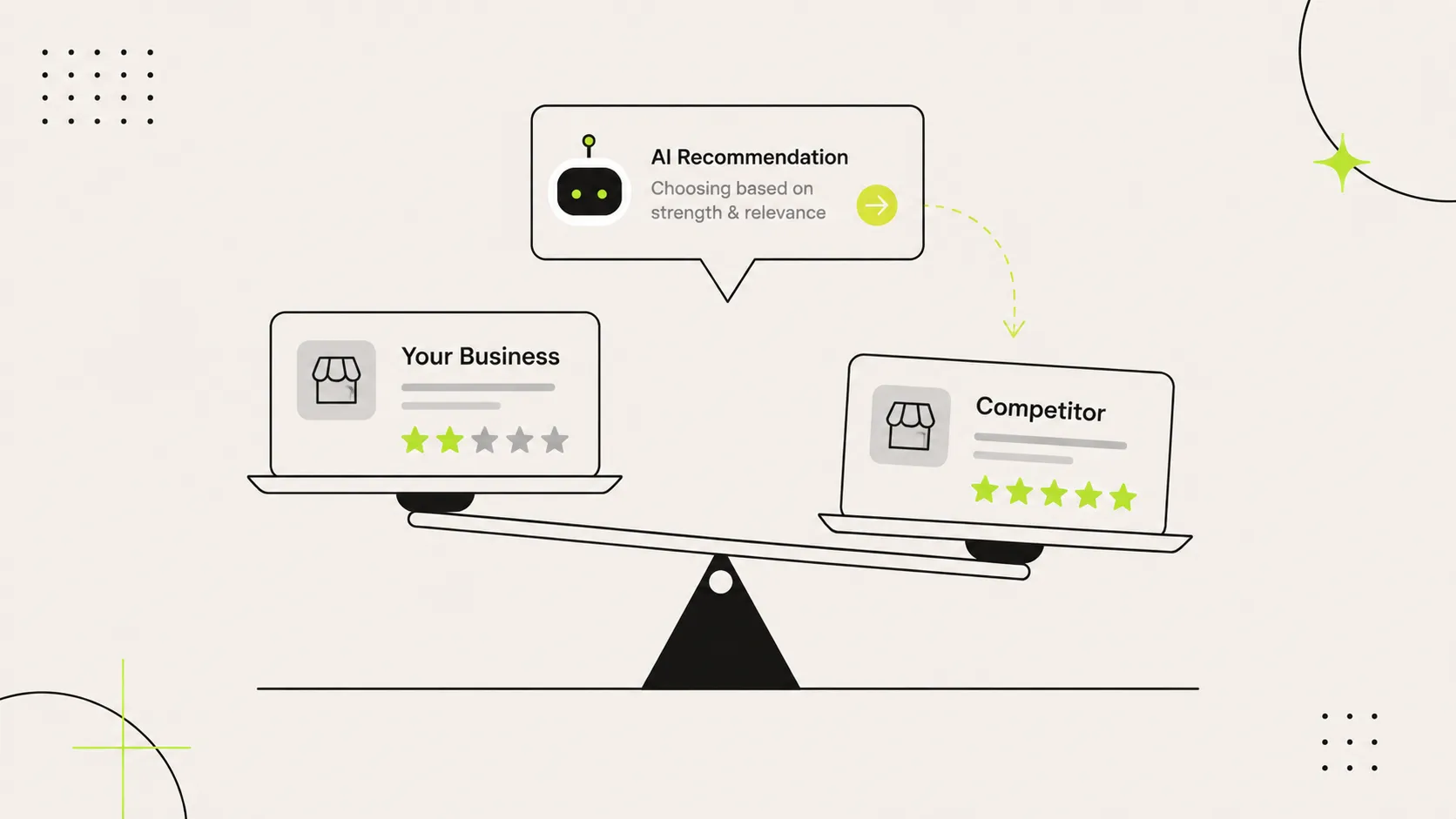
This one stings more than being invisible. You ask ChatGPT for the best business in your field, and it doesn't just skip you — it names your competitor. Confidently. As if that choice were obvious. You know your work is as good or better, and yet the AI has quietly picked a side.
So what does ChatGPT see in them that it doesn't see in you? That's the real question, and it has a real answer. When AI names a specific competitor, it's not luck. It's because, on the signals AI actually reads, they're the clearer, safer, better-supported choice right now. Let's find out exactly where — and how to close that gap.
Quick Answer
ChatGPT recommends your competitor instead of you because it can describe them more confidently than it can describe you. Usually that means they have:
- A clearer, more consistent identity across the web.
- More independent sources backing them up — reviews, directories, mentions, press.
- Content that answers buyer questions in a way AI can easily extract.
- A bigger, more established footprint that shows up in both training data and live search.
It's rarely that they "beat" you on one thing. They're simply the answer the AI can give without guessing.
Why AI plays it safe
An AI recommending a business is making a small bet on being right. Faced with a "who's the best…" question, it leans toward the option it can support with the most evidence and the least ambiguity. Confidence wins.
Your competitor probably isn't winning because they're better at their actual job. They're winning because they're easier for a machine to be sure about. Their identity is clear, their story is corroborated by other sources, and their information is consistent everywhere the AI looks. You might be just as good — but if the AI can't verify that as easily, it defaults to the safer name.
That reframe matters. This isn't a quality contest you're losing. It's an evidence contest, and evidence is something you can build.
(If ChatGPT names nobody for your searches rather than a competitor, that's a different situation — I covered it in why your business doesn't appear in ChatGPT recommendations at all. This article is specifically about when a rival is getting picked over you.)
Run the side-by-side test
Don't theorise. Put yourself and the winning competitor next to each other and look at what the AI can see. Pick the buyer question where ChatGPT names them, then compare the two of you on five things.
- Entity clarity. Search both businesses. Is it instantly obvious what each one does, who for, and where? If their identity reads clean and yours is vague or mixed up with something else, that's gap one.
- Third-party corroboration. Who talks about each of you other than yourselves? Reviews, directories, industry sites, articles, mentions. Count them honestly. Independent voices are the currency AI trusts most.
- Consistency. Are their name, location, and description the same everywhere? Are yours? Conflicting details across the web make you look unreliable to a fact-checking machine.
- Answer-shaped content. Does their site directly answer the questions buyers ask — what they offer, for whom, how much, what makes them different? Or is it, like many sites, vague marketing language a machine can't extract a clear fact from?
- Footprint and history. Have they simply been present, mentioned, and reviewed for longer? Established presence shows up in both an AI's memory and its live search.
Wherever they're clearly ahead, that's a gap you can name — and a gap you can close.
How to close the gap
Once you know where the competitor is winning, the work gets specific.
- If their identity is clearer: Sharpen yours. Make it unmistakable on your site and profiles exactly what you do, who you serve, and where. Remove ambiguity.
- If they have more corroboration: Earn independent mentions. Genuine reviews, real directory listings, industry profiles, local press. You don't need hundreds — you need a consistent, credible chorus that isn't just your own website.
- If their details are more consistent: Audit every place your business appears and make the facts identical. One name, one address format, one clear description, everywhere.
- If their content is more extractable: Rewrite your key pages to answer real questions plainly. Put the facts a buyer (and an AI) needs where they can be found, not buried in slogans.
- If they simply have more history: This is the patient one. Keep building presence and reputation consistently. Footprint compounds. The competitor's lead here shrinks as yours grows.
The honest limits
I won't pretend this is a switch you flip. A few things are worth being straight about.
AI answers vary run to run. The competitor you saw named once may appear only sometimes. Run the question several times, reworded, before you conclude they've "won." You might find the result is far less settled than one screenshot suggested.
Nobody can guarantee a swap. Anyone promising "we'll get ChatGPT to recommend you instead" is selling certainty that doesn't exist. What you can do is build the evidence that makes you a credible, safe answer — and give the AI every reason to name you.
The exact weighting is unknown. OpenAI doesn't publish how much each signal counts. We work from what's observable: clarity, corroboration, and consistency line up with who gets named. Treat anyone quoting precise percentages with suspicion.
Common mistakes
- Reacting to one result. One answer naming a competitor is noise until you've run the question several times. Measure before you spend.
- Copying the competitor's website. Their content fits their evidence. Build your own clear identity and corroboration instead of imitating theirs.
- Chasing AI while ignoring the open web. Most AI engines read the same open web you build for search. Strengthening your real presence feeds both.
- Buying "AI citation" packages. They promise a result no one controls. Save the money for genuine reputation-building.
When it isn't worth the fight
If a competitor dominates a niche with years of reviews, press, and presence, trying to overtake them in AI answers head-on may not be the best use of your effort right now — the same way it wouldn't be in normal search. It can be smarter to build clarity and corroboration around the specific things you do best, where the evidence contest is more even, and let AI find you there first.
And remember the business point: being named by ChatGPT is worth chasing only if your customers actually use AI to find businesses like yours. For some niches that's already big. For others, your buyers are still on Google Maps or coming from referrals. Fix the channel your customers actually use.
Ritesh's Take
When a competitor gets recommended and you don't, resist the urge to feel beaten. Get curious instead. Nine times out of ten, a proper side-by-side shows the AI isn't judging your quality — it's judging your clarity and evidence, and the competitor simply gave it more to work with.
That's a strangely hopeful thing. You can't easily make your service "better than theirs" overnight, but you can make your business easier for a machine to understand and trust. Clear identity, consistent facts, real third-party mentions — that's buildable work, not a mystery. Do it, and you stop being the business AI can't be sure about.
You can see the kind of AI-search visibility this builds toward in how I helped a brand become the cited answer in Google's AI results.
FAQ
Why does ChatGPT trust my competitor more than me? Because it can verify them more easily — clearer identity, more consistent information, and more independent sources describing them. It's an evidence gap, not necessarily a quality gap.
Will ChatGPT ever change who it recommends? Yes. Because it uses live web search, new content, fresh reviews, and updated listings can shift its answers within days or weeks. Nothing is permanent.
Can I pay to replace my competitor in ChatGPT's answer? No. There's no paid placement in organic recommendations as of mid-2026. The only lever is genuine clarity, consistency, and reputation.
How many times should I test before believing a result? Run the question several times, reworded, and note how often the competitor actually appears. One result tells you almost nothing given how much AI answers vary.
Does improving my SEO help here too? Yes, indirectly. The clear, consistent, well-described web presence that helps AI trust you is the same foundation that helps Google. They reinforce each other.
The one thing to do next
Pick the exact question where ChatGPT names your competitor. Put your business and theirs side by side and score both on the five signals above — clarity, corroboration, consistency, extractable content, footprint. The gap will be obvious, and it will be buildable. That's your plan.
Want me to run that comparison for you — exactly why AI is choosing your competitor and what to fix first? Get an AI search audit and I'll show you the specific gaps between you and the business getting recommended.